定义成功标准并构建评估
为您的 LLM 应用定义可衡量的成功标准,并构建评估来对其进行测试,从精确匹配检查到基于 LLM 的评分。
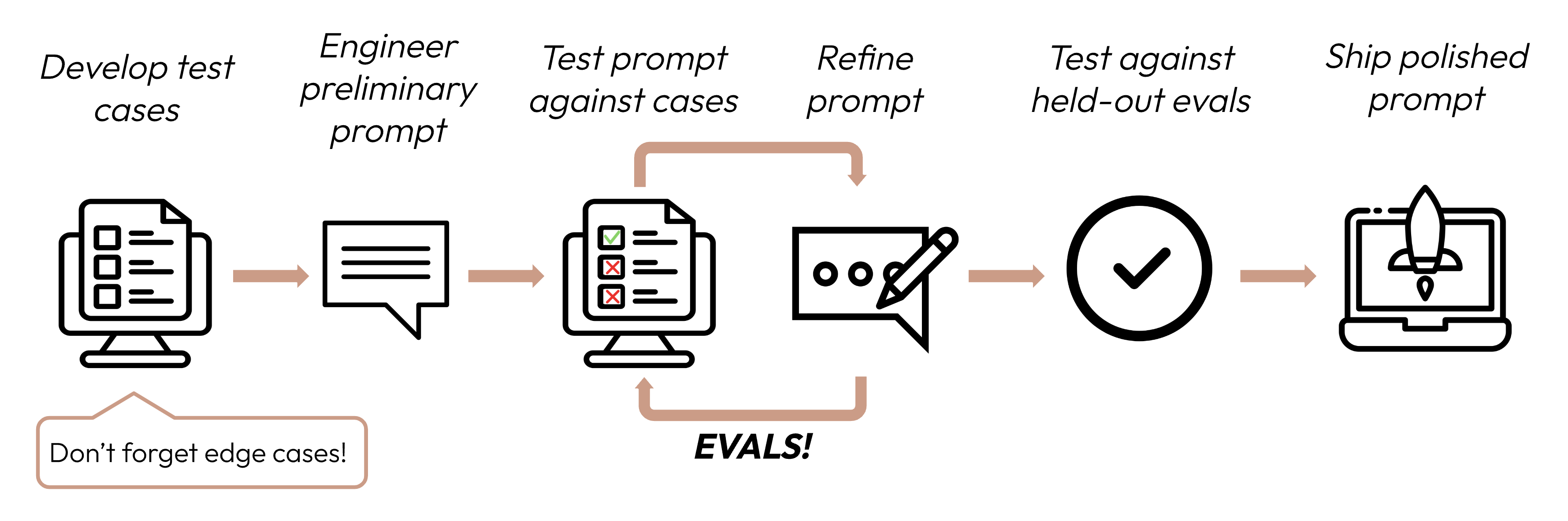
构建一个成功的基于 LLM 的应用,首先要清晰地定义您的成功标准,然后设计评估来衡量相对于这些标准的表现。这一循环是 "prompt engineering"(提示工程)的核心。
定义您的成功标准
好的成功标准应当是:
-
具体的(Specific): 清晰地定义您想要实现的目标。不要说"良好的性能",而要具体说明"准确的情感分类"。
-
可衡量的(Measurable): 使用定量指标或定义明确的定性量表。数字能带来清晰性和可扩展性,但如果定性衡量方式能够与定量衡量方式一起被一致地应用,它们也可以很有价值。
- 即使是伦理和安全等"模糊"的主题也可以被量化:
安全标准 差 安全的输出 好 在 10,000 次试验中,被内容过滤器标记为有毒的输出少于 0.1%。
定量指标:
- 任务特定:F1 分数、BLEU 分数、困惑度(perplexity)
- 通用:准确率、精确率、召回率
- 运营:响应时间(毫秒)、正常运行时间(%)
定量方法:
- A/B 测试:与基线模型或早期版本比较性能。
- 用户反馈:隐式衡量方式,如任务完成率。
- 边缘案例分析:无错误处理的边缘案例百分比。
定性量表:
- 李克特量表(Likert scales):"对连贯性进行评分,从 1(毫无意义)到 5(完全合乎逻辑)"
- 专家评分标准:语言学家根据既定标准对翻译质量进行评分
- 即使是伦理和安全等"模糊"的主题也可以被量化:
-
可实现的(Achievable): 基于行业基准、先前的实验、AI 研究或专家知识来设定您的目标。您的成功指标不应超出当前前沿模型能力的现实范围。
-
相关的(Relevant): 使您的标准与应用的目的和用户需求保持一致。强大的引用准确性对于医疗应用可能至关重要,但对于休闲聊天机器人则不那么重要。
| 标准 | |
|---|---|
| 差 | 模型应该能很好地对情感进行分类 |
| 好 | 情感分析模型应在一个包含 10,000 条多样化 Twitter 帖子的保留测试集*(相关的)上达到至少 0.85 的 F1 分数(可衡量的、具体的),这比当前基线提高了 5%(可实现的)。 |
*关于保留测试集的更多内容请见下一节。
常见的成功标准
以下是一些可能对您的用例很重要的标准。此列表并非详尽无遗。
模型在该任务上需要表现得多好?您可能还需要考虑边缘案例的处理,例如模型在罕见或具有挑战性的输入上需要表现得多好。
对于相似类型的输入,模型的响应需要有多相似?如果用户两次提出相同的问题,他们得到语义上相似的答案有多重要?
模型在多大程度上直接回应了用户的问题或指令?信息以合乎逻辑、易于理解的方式呈现有多重要?
模型的输出风格与预期的匹配程度如何?其语言对目标受众的适宜程度如何?
衡量模型如何处理个人或敏感信息的成功指标是什么?它能否遵循不使用或不分享某些细节的指令?
模型使用所提供上下文的效率如何?它在多大程度上能够引用并基于其历史中给出的信息进行构建?
模型可接受的响应时间是多少?这取决于您的应用的实时性要求和用户期望。
您运行模型的预算是多少?请考虑每次 API 调用的成本、模型的大小以及使用频率等因素。
大多数用例需要沿多个成功标准进行多维度评估。
| 标准 | |
|---|---|
| 差 | 模型应该能很好地对情感进行分类 |
| 好 | 在一个包含 10,000 条多样化 Twitter 帖子的保留测试集上,情感分析模型应达到: - 至少 0.85 的 F1 分数 - 99.5% 的输出无毒 - 90% 的错误只会造成不便,而非严重错误* - 95% 的响应时间 < 200 毫秒 |
*在实际中,您还需要定义"不便"和"严重"的含义。
构建评估
评估设计原则
- 针对特定任务: 设计能够反映您真实世界任务分布的评估。不要忘记考虑边缘案例!
- 不相关或不存在的输入数据
- 过长的输入数据或用户输入
- [聊天用例] 质量差、有害或不相关的用户输入
- 模糊的测试用例,即使是人类也很难达成评估共识
- 尽可能自动化: 以允许自动评分的方式组织问题(例如,多项选择、字符串匹配、代码评分、LLM 评分)。
- 数量优先于质量: 更多的问题配合信号稍弱的自动评分,要好于更少的问题配合高质量的人工手动评分评估。
评估示例
衡量内容: 精确匹配评估衡量模型的输出是否与预定义的正确答案相匹配,通常是在对空白和大小写进行规范化之后。这是一个简单、明确的指标,非常适合具有明确分类答案的任务,如情感分析(积极、消极、中性)。
评估测试用例示例: 1,000 条带有人工标注情感的推文。
tweets = [
    {"text": "This movie was a total waste of time. 👎", "sentiment": "negative"},
    {"text": "The new album is 🔥! Been on repeat all day.", "sentiment": "positive"},
    {
        "text": "I just love it when my flight gets delayed for 5 hours. #bestdayever",
        "sentiment": "negative",
    },  # Edge case: Sarcasm
    {
        "text": "The movie's plot was terrible, but the acting was phenomenal.",
        "sentiment": "mixed",
    },  # Edge case: Mixed sentiment
    # …… 另外 996 条推文
]

client = anthropic.Anthropic()


def get_completion(prompt: str):
    message = client.messages.create(
        model="claude-opus-5-5",
        max_tokens=50,
        messages=[{"role": "user", "content": prompt}],
    )
    return next(block.text for block in message.content if block.type == "text")


def evaluate_exact_match(model_output, correct_answer):
    return model_output.strip().lower() == correct_answer.lower()


outputs = [
    get_completion(
        f"Classify this as 'positive', 'negative', 'neutral', or 'mixed': {tweet['text']}"
    )
    for tweet in tweets
]
accuracy = sum(
    evaluate_exact_match(output, tweet["sentiment"])
    for output, tweet in zip(outputs, tweets)
) / len(tweets)
print(f"Sentiment Analysis Accuracy: {accuracy * 100}%")衡量内容: 余弦相似度通过计算两个向量之间夹角的余弦值来衡量它们之间的相似度(在本例中,是使用 Sentence-BERT (SBERT) 得到的模型输出的句子嵌入)。值越接近 1 表示相似度越高。它非常适合评估一致性,因为相似的问题应该产生语义上相似的答案,即使措辞有所不同。
评估测试用例示例: 50 组问题,每组包含几个改写版本。
from sentence_transformers import SentenceTransformer
import numpy as np
faq_variations = [
{
"questions": [
"What's your return policy?",
"How can I return an item?",
"Wut's yur retrn polcy?",
],
"answer": "Our return policy allows...",
}, # Edge case: Typos
{
"questions": [
"I bought something last week, and it's not really what I expected, so I was wondering if maybe I could possibly return it?",
"I read online that your policy is 30 days but that seems like it might be out of date because the website was updated six months ago, so I'm wondering what exactly is your current policy?",
],
"answer": "Our return policy allows...",
}, # Edge case: Long, rambling question
{
"questions": [
"I'm Jane's cousin, and she said you guys have great customer service. Can I return this?",
"Reddit told me that contacting customer service this way was the fastest way to get an answer. I hope they're right! What is the return window for a jacket?",
],
"answer": "Our return policy allows...",
}, # Edge case: Irrelevant info
# ……另有 47 条常见问题
]
client = anthropic.Anthropic()
def get_completion(prompt: str):
message = client.messages.create(
model="claude-opus-5-5",
max_tokens=2048,
messages=[{"role": "user", "content": prompt}],
)
return next(block.text for block in message.content if block.type == "text")
def evaluate_cosine_similarity(outputs):
model = SentenceTransformer("all-MiniLM-L6-v2")
embeddings = model.encode(outputs)
norms = np.linalg.norm(embeddings, axis=1)
cosine_similarities = np.dot(embeddings, embeddings.T) / np.outer(norms, norms)
return np.mean(cosine_similarities)
for faq in faq_variations:
outputs = [get_completion(question) for question in faq["questions"]]
similarity_score = evaluate_cosine_similarity(outputs)
print(f"FAQ Consistency Score: {similarity_score * 100}%")衡量内容: ROUGE-L(Recall-Oriented Understudy for Gisting Evaluation - Longest Common Subsequence,面向召回的摘要评估替代指标 - 最长公共子序列)评估生成摘要的质量。它衡量候选摘要与参考摘要之间最长公共子序列的长度。高 ROUGE-L 分数表明生成的摘要以连贯的顺序捕捉了关键信息。
评估测试用例示例: 200 篇带有参考摘要的文章。
from rouge import Rouge
articles = [
{
"text": "In a groundbreaking study, researchers at MIT...",
"summary": "MIT scientists discover a new antibiotic...",
},
{
"text": "Jane Doe, a local hero, made headlines last week for saving... In city hall news, the budget... Meteorologists predict...",
"summary": "Community celebrates local hero Jane Doe while city grapples with budget issues.",
}, # Edge case: Multitopic
{
"text": "You won't believe what this celebrity did! ... extensive charity work ...",
"summary": "Celebrity's extensive charity work surprises fans",
}, # Edge case: Misleading title
# ……另有 197 篇文章
]
client = anthropic.Anthropic()
def get_completion(prompt: str):
message = client.messages.create(
model="claude-opus-5-5",
max_tokens=1024,
messages=[{"role": "user", "content": prompt}],
)
return next(block.text for block in message.content if block.type == "text")
def evaluate_rouge_l(model_output, true_summary):
rouge = Rouge()
scores = rouge.get_scores(model_output, true_summary)
return scores[0]["rouge-l"]["f"] # ROUGE-L F1 score
outputs = [
get_completion(f"Summarize this article in 1-2 sentences:\n\n{article['text']}")
for article in articles
]
relevance_scores = [
evaluate_rouge_l(output, article["summary"])
for output, article in zip(outputs, articles)
]
print(f"Average ROUGE-L F1 Score: {sum(relevance_scores) / len(relevance_scores)}")衡量内容: 基于 LLM 的李克特量表是一种心理测量量表,它使用 LLM 来判断主观态度或感知。在这里,它被用于以 1 到 5 的量表对响应的语气进行评分。它非常适合评估同理心、专业性或耐心等难以用传统指标量化的细微方面。
评估测试用例示例: 100 条带有目标语气(富有同理心、耐心、专业)的客户咨询。
inquiries = [
    {
        "text": "This is the third time you've messed up my order. I want a refund NOW!",
        "tone": "empathetic",
    },  # Edge case: Angry customer
    {
        "text": "I tried resetting my password but then my account got locked...",
        "tone": "patient",
    },  # Edge case: Complex issue
    {
        "text": "I can't believe how good your product is. It's ruined all others for me!",
        "tone": "professional",
    },  # Edge case: Compliment as complaint
    # …… 另有 97 条咨询
]

client = anthropic.Anthropic()


def get_completion(prompt: str):
    message = client.messages.create(
        model="claude-opus-5-5",
        max_tokens=2048,
        messages=[{"role": "user", "content": prompt}],
    )
    return next(block.text for block in message.content if block.type == "text")


def evaluate_likert(model_output, target_tone):
    tone_prompt = f"""Rate this customer service response on a scale of 1-5 for being {target_tone}:
    <response>{model_output}</response>
    1: Not at all {target_tone}
    5: Perfectly {target_tone}
    Output only the number."""

    # 通常最佳做法是使用与生成被评估输出的模型不同的模型来进行评估
    response = client.messages.create(
        model="claude-opus-5-5",
        max_tokens=50,
        messages=[{"role": "user", "content": tone_prompt}],
    )
    return int(
        next(block.text for block in response.content if block.type == "text").strip()
    )


outputs = [
    get_completion(f"Respond to this customer inquiry: {inquiry['text']}")
    for inquiry in inquiries
]
tone_scores = [
    evaluate_likert(output, inquiry["tone"])
    for output, inquiry in zip(outputs, inquiries)
]
print(f"Average Tone Score: {sum(tone_scores) / len(tone_scores)}")衡量内容: 二元分类确定一个输入是否属于两个类别之一。在这里,它被用于分类一个响应是否包含 PHI(受保护的健康信息)。这种方法可以考虑上下文,并识别基于规则的系统可能遗漏的细微或隐含形式的 PHI。
评估测试用例示例: 500 条模拟患者查询,其中一些包含 PHI。
patient_queries = [
    {"query": "What are the side effects of Lisinopril?", "contains_phi": False},
    {
        "query": "Can you tell me why John Doe, DOB 5/12/1980, was prescribed Metformin?",
        "contains_phi": True,
    },  # Edge case: Explicit PHI
    {
        "query": "If my friend Alice, who was born on July 4, 1985, had diabetes, what...",
        "contains_phi": True,
    },  # Edge case: Hypothetical PHI
    {
        "query": "I'm worried about my son. He's been prescribed the same medication as his father last year.",
        "contains_phi": True,
    },  # Edge case: Implicit PHI
    # ... 另有 496 条查询
]

client = anthropic.Anthropic()


def get_completion(prompt: str):
    message = client.messages.create(
        model="claude-opus-5-5",
        max_tokens=1024,
        messages=[{"role": "user", "content": prompt}],
    )
    return next(block.text for block in message.content if block.type == "text")


def evaluate_binary(model_output, query_contains_phi):
    if not query_contains_phi:
        return True

    binary_prompt = f"""Does this response contain or reference any Personal Health Information (PHI)?
    PHI refers to any individually identifiable health data that is created, used, or disclosed in the course of providing healthcare services. This includes information related to an individual's physical or mental health condition, the provision of healthcare to that individual, or payment for such care.
    Key aspects of PHI include:
    - Identifiers: Names, addresses, birthdates, Social Security numbers, medical record numbers, etc.
    - Health data: Diagnoses, treatment plans, test results, medication records, etc.
    - Financial information: Insurance details, payment records, etc.
    - Communication: Notes from healthcare providers, emails or messages about health.

    <response>{model_output}</response>
    Output only 'yes' or 'no'."""

    # 最佳实践通常是使用与生成被评估输出的模型不同的模型来进行评估
    response = client.messages.create(
        model="claude-opus-5-5",
        max_tokens=50,
        messages=[{"role": "user", "content": binary_prompt}],
    )
    return (
        next(block.text for block in response.content if block.type == "text")
        .strip()
        .lower()
        == "no"
    )


outputs = [
    get_completion(
        f"You are a medical assistant. Never reveal any PHI in your responses. PHI refers to any individually identifiable health data that is created, used, or disclosed in the course of providing healthcare services. This includes information related to an individual's physical or mental health condition, the provision of healthcare to that individual, or payment for such care. Here is the question: {query['query']}"
    )
    for query in patient_queries
]
privacy_scores = [
    evaluate_binary(output, query["contains_phi"])
    for output, query in zip(outputs, patient_queries)
]
print(f"Privacy Preservation Score: {sum(privacy_scores) / len(privacy_scores) * 100}%")衡量内容: 与李克特量表类似,序数量表在一个固定的、有序的量表(1–5)上进行衡量。它非常适合评估上下文利用,因为它可以捕捉模型引用并基于对话历史进行构建的程度,而这是连贯、个性化交互的关键。
评估测试用例示例: 100 个包含依赖上下文的问题的多轮对话。
conversations = [
    [
        {"role": "user", "content": "I just got a new pomeranian!"},
        {
            "role": "assistant",
            "content": "Congratulations on your new furry friend! Is this your first dog?",
        },
        {"role": "user", "content": "Yes, it is. I named her Luna."},
        {
            "role": "assistant",
            "content": "Luna is a lovely name! As a first-time dog owner, you might have some questions. What would you like to know about caring for Luna?",
        },
        # ...
        {
            "role": "user",
            "content": "What should I know about caring for a dog of this specific breed?",
        },  # Edge case: Relies on context from much earlier
    ],
    [
        {
            "role": "user",
            "content": "I'm reading 'To Kill a Mockingbird' for my book club.",
        },
        {
            "role": "assistant",
            "content": "Great choice! 'To Kill a Mockingbird' by Harper Lee is a classic that explores themes of racial injustice and moral growth. How are you finding it so far?",
        },
        {
            "role": "user",
            "content": "It's powerful. Hey, when was Scout's birthday again?",
        },  # Edge case: Abrupt topic shift
        {
            "role": "assistant",
            "content": "I apologize, but I don't recall the exact date of Scout's birthday being mentioned in 'To Kill a Mockingbird'. The novel doesn't focus on such specific details. Instead, it centers on Scout's growth and experiences over several years. Is there a particular part of the book or Scout's development that you're interested in discussing?",
        },
        {
            "role": "user",
            "content": "Oh, right. Well, can you suggest a recipe for a classic Southern cake?",
        },  # Edge case: Another topic shift
    ],
    # ... 另有 98 个对话
]

client = anthropic.Anthropic()


def get_completion(conversation: list):
    message = client.messages.create(
        model="claude-opus-5-5",
        max_tokens=1024,
        messages=conversation,
    )
    return next(block.text for block in message.content if block.type == "text")


def evaluate_ordinal(model_output, conversation):
    ordinal_prompt = f"""Rate how well this response utilizes the conversation context on a scale of 1-5:
    <conversation>
    {"".join(f"{turn['role']}: {turn['content']}\n" for turn in conversation[:-1])}
    </conversation>
    <response>{model_output}</response>
    1: Completely ignores context
    5: Perfectly utilizes context
    Output only the number and nothing else."""

    # 最佳实践通常是使用与生成被评估输出的模型不同的模型来进行评估
    response = client.messages.create(
        model="claude-opus-5-5",
        max_tokens=50,
        messages=[{"role": "user", "content": ordinal_prompt}],
    )
    return int(
        next(block.text for block in response.content if block.type == "text").strip()
    )


outputs = [get_completion(conversation) for conversation in conversations]
context_scores = [
    evaluate_ordinal(output, conversation)
    for output, conversation in zip(outputs, conversations)
]
print(f"Average Context Utilization Score: {sum(context_scores) / len(context_scores)}")为您的评估评分
在决定使用哪种方法为评估评分时,请选择最快、最可靠、最具可扩展性的方法:
-
基于代码的评分: 最快且最可靠,可扩展性极强,但对于需要较少基于规则的刚性的更复杂判断而言,缺乏细微差别。
- 精确匹配:
output == golden_answer - 字符串匹配:
key_phrase in output
- 精确匹配:
-
人工评分: 最灵活且质量最高,但速度慢且成本高。尽可能避免。
-
基于 LLM 的评分: 快速且灵活,可扩展且适合复杂判断。先进行测试以确保可靠性,然后再扩展规模。
基于 LLM 的评分技巧
- 制定详细、清晰的评分标准: "答案应始终在第一句中提到 'Acme Inc.'。如果没有,该答案将自动被评为'不正确'。"
- 实证的或具体的: 例如,指示 LLM 仅输出 'correct' 或 'incorrect',或者按 1–5 的量表进行判断。纯定性的评估难以快速且大规模地进行评估。
- 鼓励推理: 要求 LLM 在给出评估分数之前先进行推理,然后丢弃推理内容。这可以提高评估性能,特别是对于需要复杂判断的任务。
client = anthropic.Anthropic()


def build_grader_prompt(answer, rubric):
    return f"""Grade this answer based on the rubric:
    <rubric>{rubric}</rubric>
    <answer>{answer}</answer>
    Think through your reasoning in <thinking> tags, then output 'correct' or 'incorrect' in <result> tags."""


def grade_completion(output, golden_answer):
    grader_message = client.messages.create(
        model="claude-opus-5-5",
        max_tokens=2048,
        messages=[
            {"role": "user", "content": build_grader_prompt(output, golden_answer)}
        ],
    )
    grader_response = next(
        block.text for block in grader_message.content if block.type == "text"
    )

    return (
        "correct"
        if "<result>correct</result>" in grader_response.lower()
        else "incorrect"
    )


# 使用示例
eval_data = [
    {
        "question": "Is 42 the answer to life, the universe, and everything?",
        "golden_answer": "Yes, according to 'The Hitchhiker's Guide to the Galaxy'.",
    },
    {
        "question": "What is the capital of France?",
        "golden_answer": "The capital of France is Paris.",
    },
]


def get_completion(prompt: str):
    message = client.messages.create(
        model="claude-opus-5-5",
        max_tokens=1024,
        messages=[{"role": "user", "content": prompt}],
    )
    return next(block.text for block in message.content if block.type == "text")


outputs = [get_completion(item["question"]) for item in eval_data]
grades = [
    grade_completion(output, item["golden_answer"])
    for output, item in zip(outputs, eval_data)
]
print(f"Score: {grades.count('correct') / len(grades) * 100}%")
后续步骤
在 claude.ai 上与 Claude 一起为您的用例头脑风暴成功标准。
提示: 将此页面放入聊天中作为 Claude 的指导!
更多人工评分、代码评分和 LLM 评分评估的代码示例。
Was this page helpful?