Configure Azure Key Vault for CMEK
Use Azure Key Vault to provide an encryption key for your organization.
claude "/claude-api help me configure a customer-managed encryption key with Azure Key Vault"This guide walks through configuring an Azure Key Vault key as a customer-managed encryption key (CMEK) for your Anthropic organization.
Prerequisites
- An Azure Key Vault with RBAC authorization enabled (
enableRbacAuthorization: true) and public network access allowed. Anthropic calls your vault over the public data-plane endpoint; private endpoints are not supported. - Purge protection enabled (
enablePurgeProtection: true) on the vault. Without it, a deleted key can be permanently purged during the soft-delete retention window, causing irreversible loss of your CMEK-protected data. Purge protection cannot be disabled once enabled. - Permissions to create keys in the vault and to assign RBAC roles on it.
- Permissions to create service principals in your Entra tenant (
Application Administrator,Cloud Application Administrator, or an equivalent custom role). - An Anthropic Admin API key for your organization.
- The
azCLI installed and authenticated. - Diagnostic Settings configured on the vault to route the
AuditEventlog category to Log Analytics, a storage account, or an event hub. Azure Key Vault does not emit data-plane audit logs (such asKeyWrap,KeyUnwrap, andKeyGet) by default, so without this you get no audit trail for Anthropic's key operations.
Anthropic app information
To have Anthropic use your encryption key, you must configure an Anthropic multitenant application ID and display name. Those values are:
| Field | Value |
|---|---|
| Multitenant app client ID (US) | 8635ae1a-3e5d-44e8-a4ed-e0f614466f87 |
| App display name | anthropic-cmek-client-us |
Encryption key setup
Consent to the Anthropic multitenant application
This creates a service principal in your Entra tenant for Anthropic's CMEK client application. The application requests no Microsoft Graph permissions; it exists solely as a federation target for Key Vault data-plane access.
az ad sp create --id 8635ae1a-3e5d-44e8-a4ed-e0f614466f87From the output, capture the
idfield. This is the service principal's object ID in your tenant, which you use when you assign the RBAC role.{ "appId": "8635ae1a-3e5d-44e8-a4ed-e0f614466f87", "displayName": "anthropic-cmek-client-us", "id": "<sp-object-id>" }If the service principal already exists in your tenant (from a prior attempt or another integration),
az ad sp createexits with an "already exists" error. Fetch its object ID instead:az ad sp show --id 8635ae1a-3e5d-44e8-a4ed-e0f614466f87 --query id -o tsvThis step has no Portal equivalent. If you do not have the Azure CLI installed locally, open Cloud Shell from the Portal's top navigation bar. After the command succeeds, you can find the service principal's object ID in Microsoft Entra ID > Enterprise applications by clearing the default application-type filter and searching for
anthropic-cmek-client-us.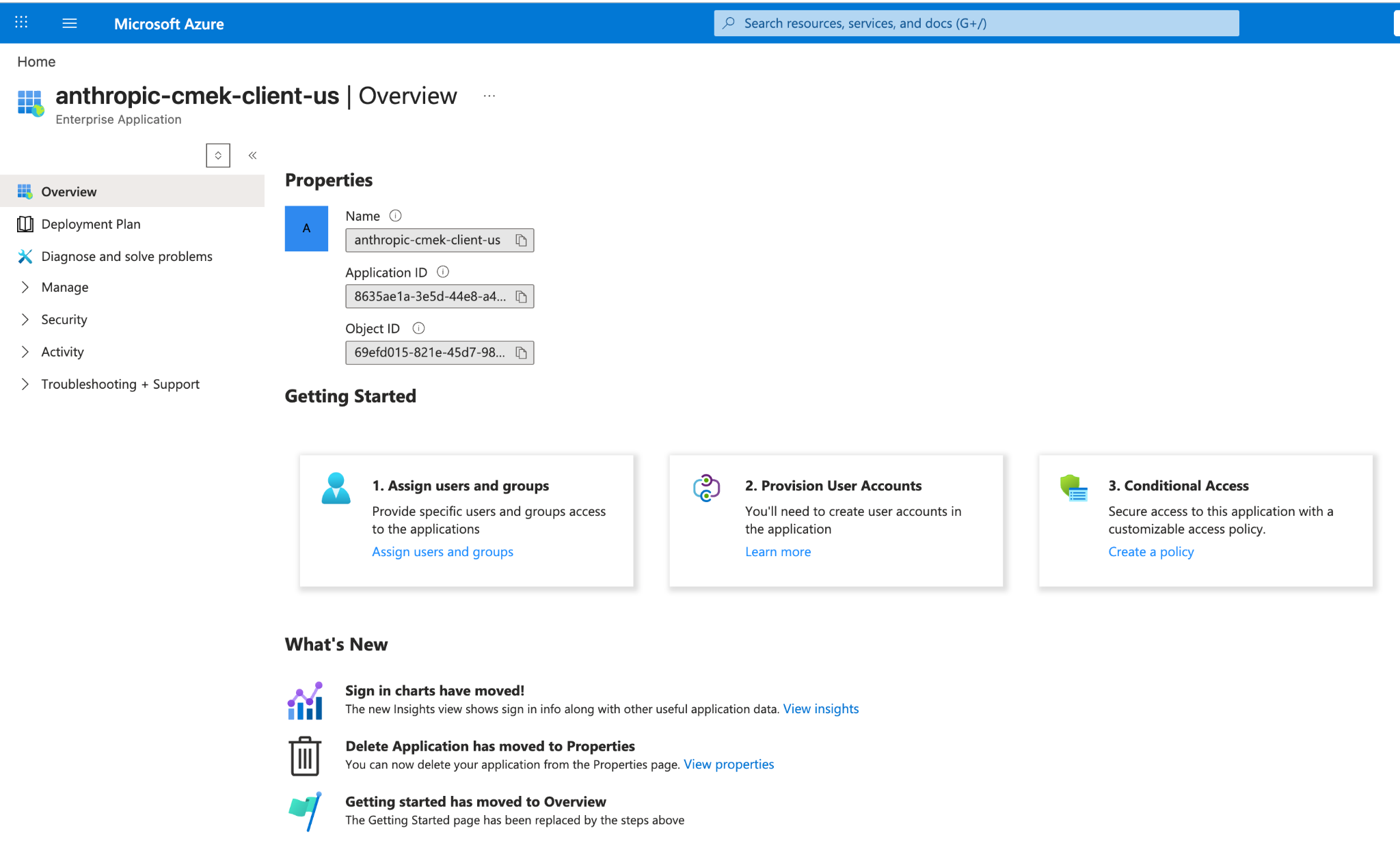
Find the service principal's Object ID on its Entra enterprise application overview. Create an RSA key in your vault
Azure Key Vault does not support symmetric key wrapping, so the key must be RSA (3072-bit or larger) with
wrapKeyandunwrapKeyin its allowed operations.The
--tagsoption adds the organization tag,anthropic-org-<ORGANIZATION_UUID>with the valuetrue, where<ORGANIZATION_UUID>is your Anthropic organization ID in lowercase. The tag is required for Anthropic to validate the key.az keyvault key create \ --vault-name <VAULT_NAME> \ --name <KEY_NAME> \ --kty RSA --size 3072 \ --ops wrapKey unwrapKey \ --tags anthropic-org-<ORGANIZATION_UUID>=trueFor HSM-backed keys, use
--kty RSA-HSM(requires a Premium-SKU vault). Software-protected RSA keys are acceptable for this integration.From the Portal, open your Key Vault, select Keys, then Generate/Import. Set the key type to RSA and the size to 3072 or larger. To restrict the key to wrap and unwrap only, open the key version, scroll to Permitted operations, and uncheck everything except Wrap Key and Unwrap Key.
On the Create a key page, also add the organization tag under Tags.
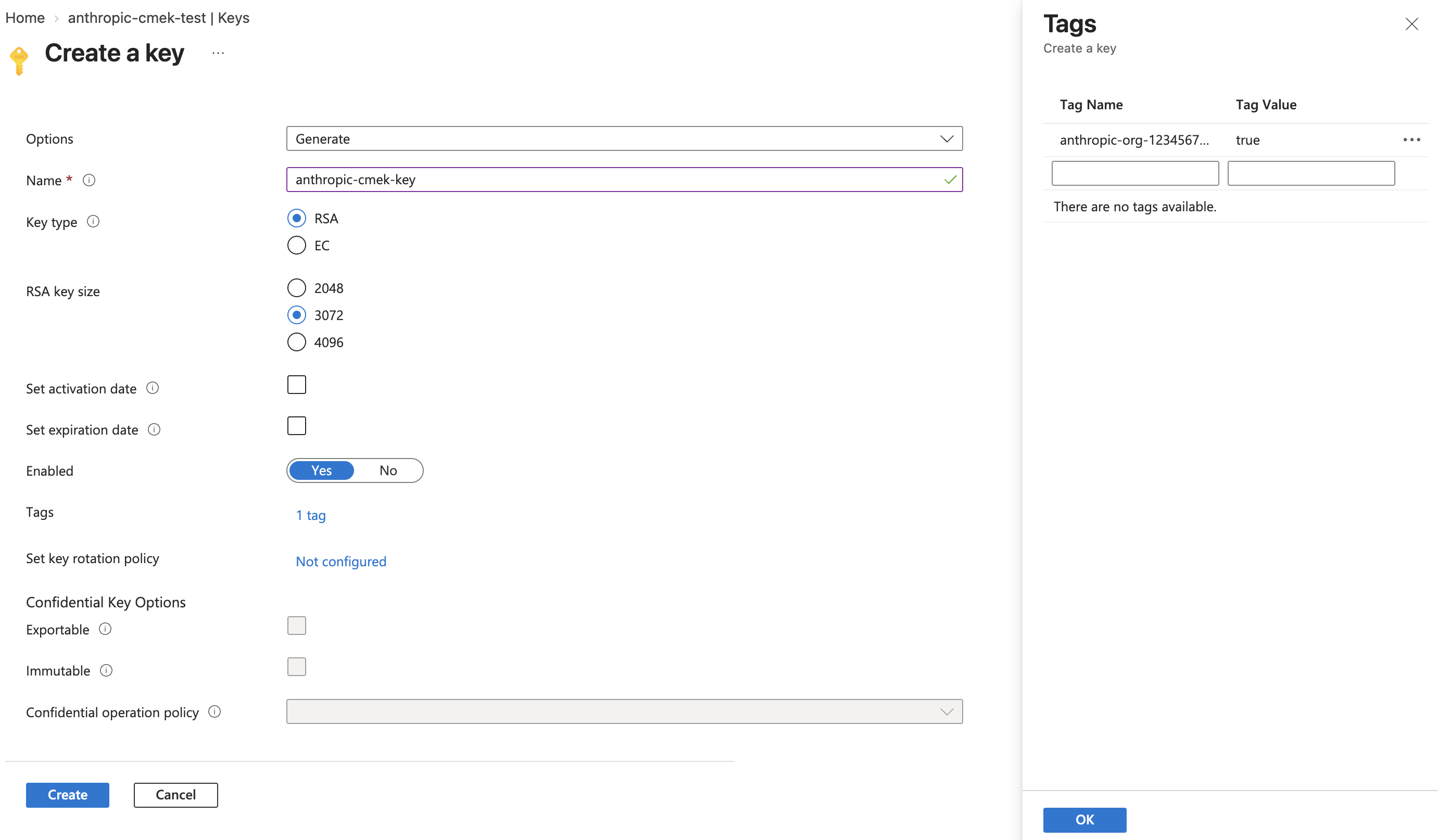
Create an RSA key sized 3072 or larger, with the tag anthropic-org-<ORGANIZATION_UUID> set to true. 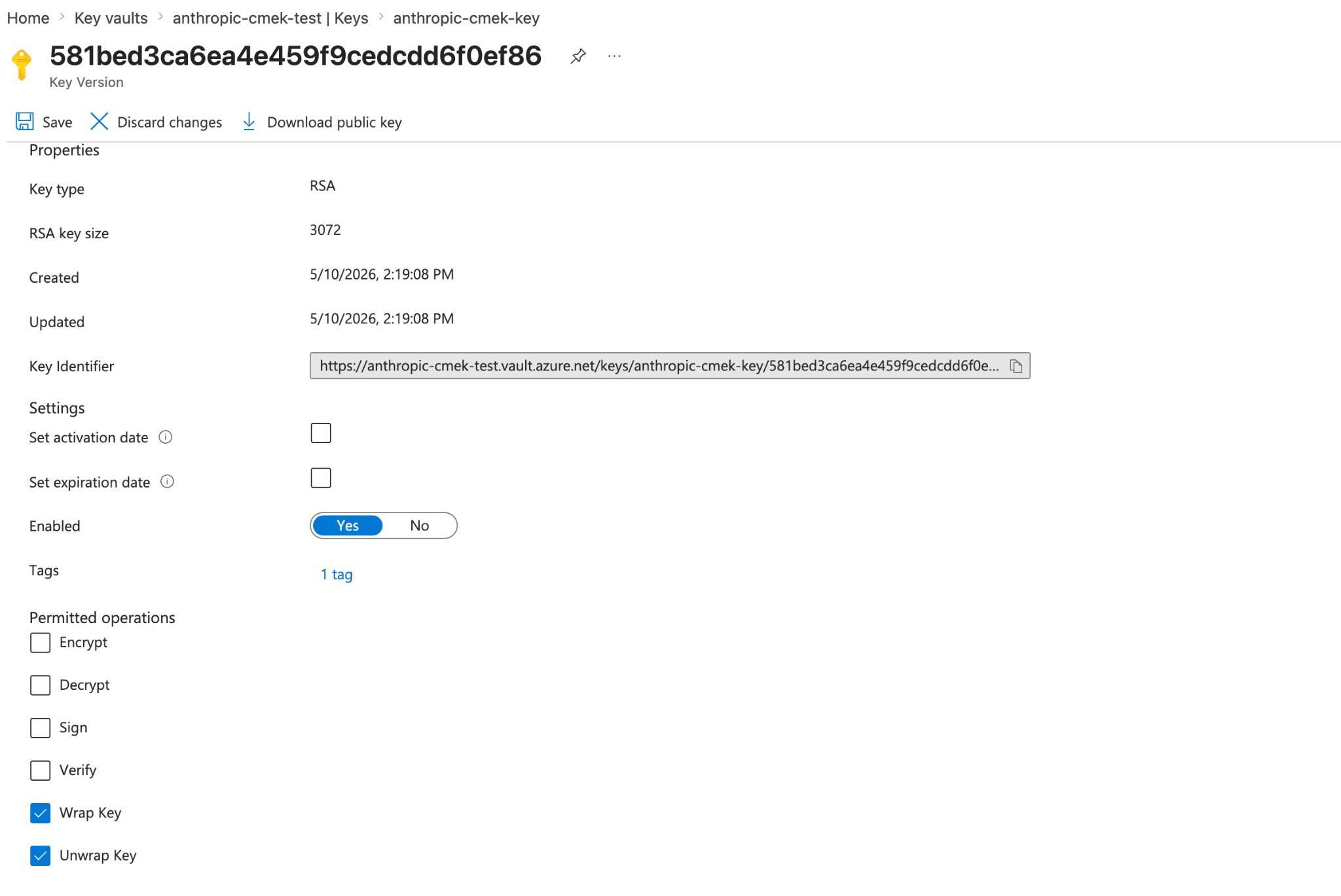
Restrict permitted operations to Wrap Key and Unwrap Key. The key version shows the organization tag. To share one key among several Anthropic organizations, add one such tag for each organization. A key version can carry at most 15 tags, including your own.
Grant the Anthropic service principal access to your key
Assign the
Key Vault Crypto Userrole to the service principal from the first step, scoped to the individual key rather than the whole vault.VAULT_ID=$(az keyvault show --name <your-vault-name> --query id -o tsv) az role assignment create \ --role "Key Vault Crypto User" \ --assignee-object-id <sp-object-id> \ --assignee-principal-type ServicePrincipal \ --scope "${VAULT_ID}/keys/<your-key-name>"The built-in
Key Vault Crypto Userrole grants key cryptographic operations (encrypt, decrypt, wrap, unwrap, sign, verify) plus key read on its assigned scope. The--ops wrapKey unwrapKeyrestriction you set on the key in the previous step further narrows which of those operations can succeed against this key, so in practice Anthropic can only wrap and unwrap.From the Portal, open the key (not the vault), select its Access control (IAM) tab, click Add > Add role assignment, select Key Vault Crypto User, and assign it to the
anthropic-cmek-client-usservice principal.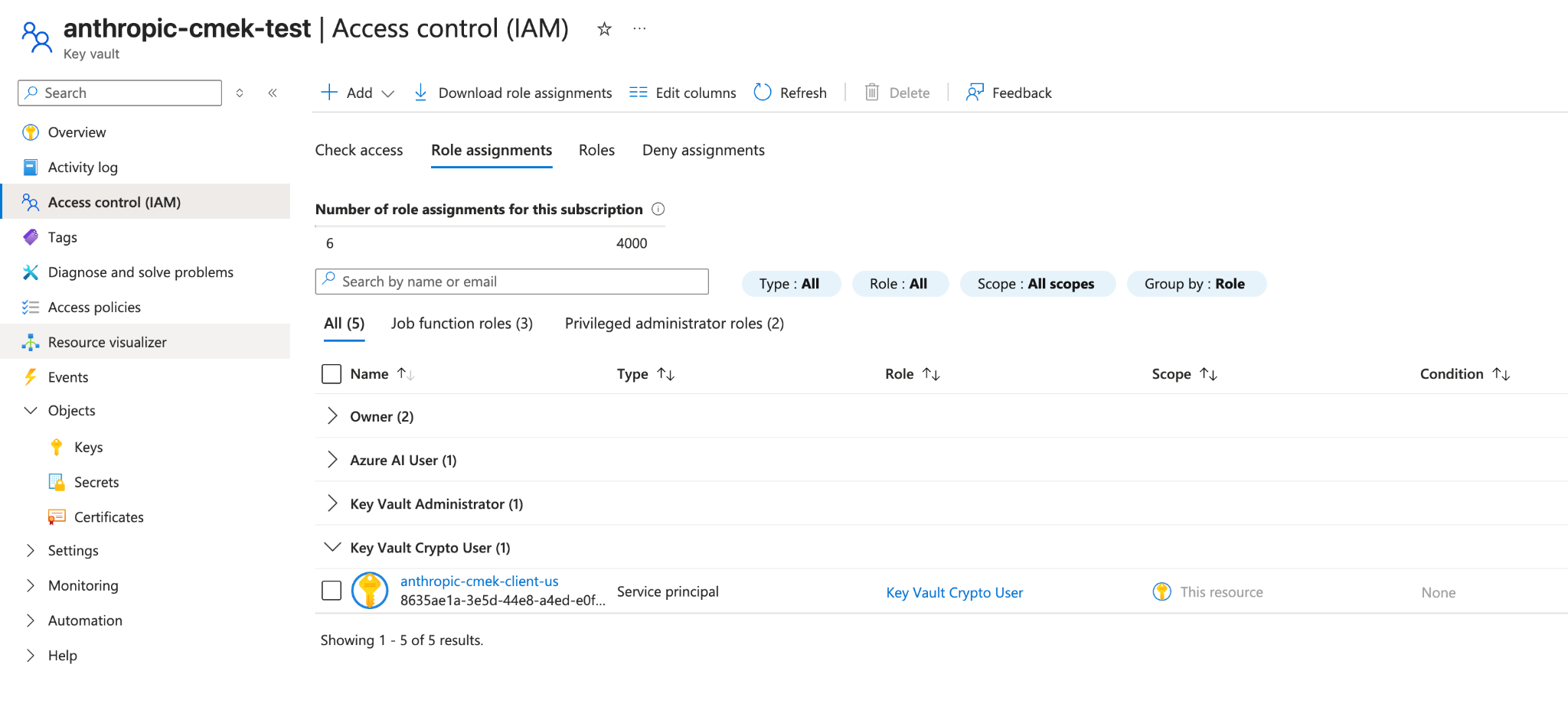
Assign Key Vault Crypto User to the Anthropic service principal, scoped to the key. Verify your vault configuration
az keyvault show --name <your-vault-name> \ --query "{rbac:properties.enableRbacAuthorization, purge:properties.enablePurgeProtection, pub:properties.publicNetworkAccess, net:properties.networkAcls.defaultAction, ipRules:properties.networkAcls.ipRules, uri:properties.vaultUri, tenantId:properties.tenantId}"Confirm that:
rbacistrue.purgeistrue. If it isfalseornull, enable purge protection on the vault before proceeding. Without it, a soft-deleted key can be permanently purged during the retention window, making your CMEK-protected data unrecoverable.pubis"Enabled". If it is"Disabled", Anthropic cannot reach the vault over its public data-plane endpoint and validation fails.netis"Allow", or, if it is"Deny", thatipRulesinclude Anthropic's egress ranges (contact Anthropic for the current list).uriis the vault URI you use when you register the key.tenantIdis the tenant that governs the vault. Use this value astenant_idwhen you register the key, not the tenant of your currently-active subscription (the two can differ in cross-tenant setups).
Register the key with Anthropic
How you register the key depends on which product you use.
You can set up the key in the Claude Console or through the Admin API, with the same result.
Register the key with Anthropic
In the Claude Console, go to the Data retention page (
platform.claude.com/settings/privacy). If you don't see Encryption keys, select Organization from the dropdown menu at the top of the page. Under Encryption keys, click Add key. Enter a display name, choose Azure Key Vault, and click Continue. Fill in Vault URI, Key name, and Tenant ID, and click Add.The key details step shows the organization tag. Add it to the key, as the create step describes, before you click Add.
Validate the key
In the Encryption keys list, click Verify next to the key. Connected appears when the check passes. If it fails, a message gives the reason.
Attach the key to a workspace
In the Claude Console, go to the Data retention page (
platform.claude.com/settings/privacy) and select the workspace from the dropdown menu at the top of the page. Under Encryption key, select the key, click Save, and confirm. Attaching a key can't be undone. For a workspace that already receives requests, the key can take up to a day to take effect.
Register the key with Anthropic
Create an external key configuration through the Admin API.
Pythonclient = anthropic.Anthropic() external_key = client.organization.external_keys.create( display_name="<friendly-name>", geo="us", provider_config={ "type": "azure", "vault_uri": "https://<your-vault-name>.vault.azure.net/", "key_name": "<your-key-name>", "tenant_id": "<your-tenant-id>", }, ) print(f"id: {external_key.id}") print(f"display_name: {external_key.display_name}")The response contains the external key ID:
{ "type": "external_key", "id": "ekey_<id>", "display_name": "<friendly-name>" }Validate the key
Trigger an encrypt and decrypt round-trip against your key. This confirms that Anthropic can authenticate to your tenant and perform wrap and unwrap operations.
Pythonclient = anthropic.Anthropic() validation = client.organization.external_keys.validate("ekey_<id>") print(f"status: {validation.status}") print(f"error: {validation.error}")A successful response looks like this:
{ "type": "external_key_validation", "status": "success", "error": null }If validation fails, the
errorfield describes the problem. Common causes are:- RBAC propagation delay: role assignments can take a few minutes to take effect. Wait and retry.
- Network ACLs blocking Anthropic: confirm public network access and
ipRulesas described in the verification step. - Conditional access policies on workload identities: if your tenant has conditional access policies that target service principals, exclude the Anthropic service principal or add Anthropic's egress ranges to the policy's named locations.
Attach the key to a workspace
Once the key is validated, attach it to a new workspace before you send any requests to that workspace. For a workspace that already receives requests, the key can take up to a day to take effect.
Pythonclient = anthropic.Anthropic() workspace = client.organization.workspaces.update( "<workspace-id>", external_key_id="ekey_<id>" ) print(f"id: {workspace.id}") print(f"external_key_id: {workspace.external_key_id}")
In claude.ai > Organization settings > Data and privacy, open Encryption keys, then click Add key. Choose Azure, enter the vault URI, key name, and tenant ID from the verification step, and click Continue. Anthropic validates the key with an encrypt and decrypt round-trip. Once it shows as verified, your organization is CMEK-protected from that point forward.
On Claude Enterprise, CMEK applies to the whole organization, so there is no separate workspace attach step, and an organization can have only one key.
Terraform
For infrastructure-as-code deployments, the same steps map to the azurerm and azuread providers.
Was this page helpful?