
Content policy enforcement with Claude
Content moderation is the process of checking content against a written policy before it goes out, then deciding what happens to it: publish, reject, or send to a human reviewer. The content can come from anywhere: user comments, seller listings, ad creatives, marketing campaigns that legal must clear. The policy is written in plain English by a policy, legal, or brand team, and content arrives faster than any review team can read. Every owner of this loop lives with the same tension: policy is written by people, in prose, but enforcement needs to be consistent, cheap, and auditable.
In this guide, you'll build a content moderation pipeline where Claude compiles that written policy into deterministic, auditable rules. You'll compile a realistic ad-clearance policy, extract typed fields from content (including creative images), and produce verdicts from a rule engine that never calls a model, then run the same pipeline over three domains and measure it against labeled samples.
All data in this notebook is synthetic. The companies, brands, policies, and creative images are made up for this guide. The rules shown illustrate the pattern and do not represent real advertising or moderation requirements, so don't use them as compliance guidance.
What you'll learn
- Designing an extraction schema whose descriptions double as extraction instructions
- A small JSON rule language with scopes and three-valued logic
- Compiling policy prose with a validator-driven repair loop
- LLM assertions: rules like "no one who looks under 25" as model-judged fields
- Extraction with structured outputs, including from images
- Adding a rule from one plain-English sentence
- Evaluating against labeled samples across three domains
Prerequisites
- Python 3.10+ and an Anthropic API key (
ANTHROPIC_API_KEYin your environment or a.envfile; the setup cell loads it). - Data ships alongside the notebook (
data/<domain>/): schemas, policy documents, labeled samples, and synthetic creative images (all brands fictional, generated with Pillow, so ground-truth labels are correct by construction).
The engine and the two Claude stages live in engine.py and pipeline.py next to this
notebook. The guide imports them and shows the parts worth reading. If you're reading
this on the cookbook site, the full files are on GitHub:
engine.py(opens in new tab) and pipeline.py(opens in new tab).
Cost and runtime. The notebook makes real API calls: roughly 10 to 15 minutes and
about a dollar with defaults; RUN_FULL_EVAL=1 (Step 10) doubles that. The committed
outputs are from a full run, so you can also just read along.
The approach
The obvious LLM build is to paste the policy into a prompt and ask for a verdict. It works in a demo and causes problems at production volume:
| Prompt-based verdicts | What production needs |
|---|---|
| The same content can get different verdicts on different runs | Identical inputs, identical decisions |
| Rejections explained by whatever prose the model generated | An evidence trail: rule, assertion, expected vs. actual |
| A policy change is an unreviewable prompt edit | Versioned, diffable rule artifacts you can replay |
This cookbook restructures the problem so Claude runs in exactly two places, and never decides the verdict:
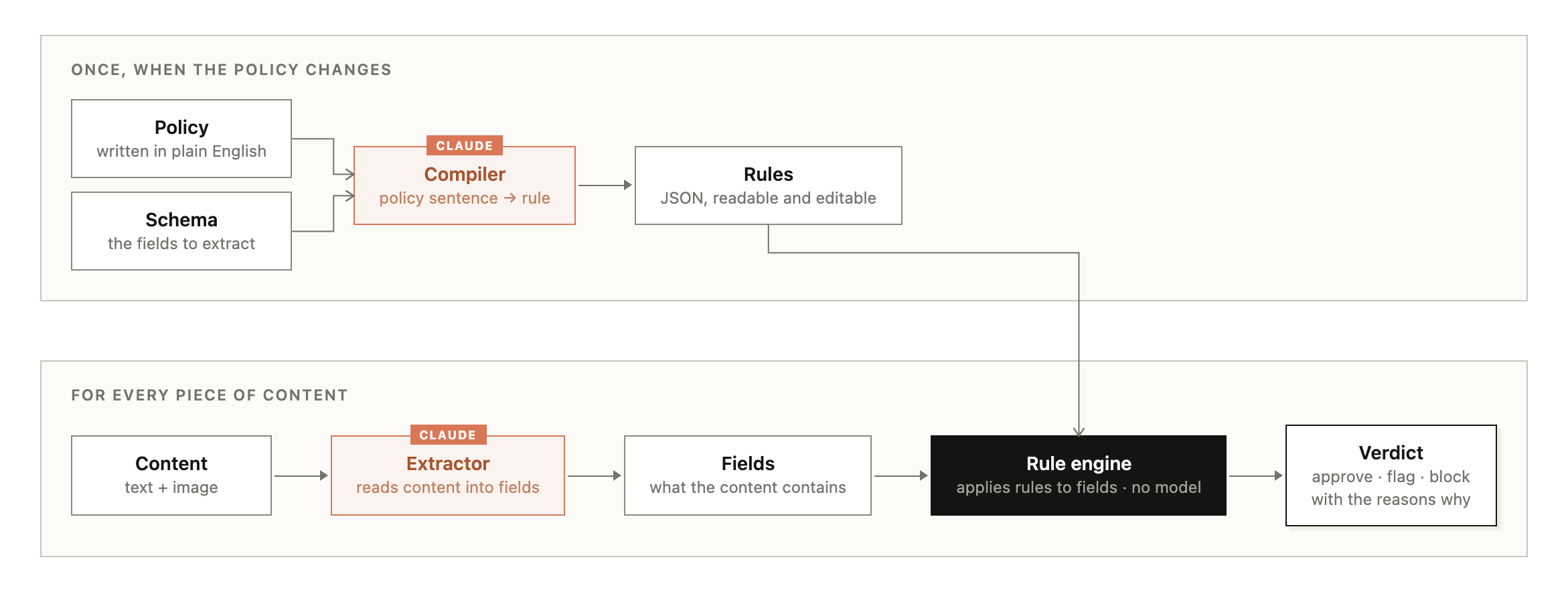
- Schema (you write it): the typed fields that can be known about a piece of content.
- Compiler (Claude, once per policy change): turns each policy clause into rules over those fields, checked by a static validator.
- Extractor (Claude, once per piece of content): one call reads text and image into typed fields.
- Engine (no model): applies rules to fields. Same inputs, same verdict, with a per-assertion audit trail.
Rules engines were always trustworthy; what they never had was a way to read policy like a policy person and content like a reviewer. That's the part Claude supplies.
The worked example is ad-creative clearance for Northwind, a fictional media network. Two more domains, marketplace listings and community content, reuse every line of code.
Step 1: Define the extraction schema
Everything in this pipeline builds on the schema, so we start there. The schema is the contract between the model and the rule engine: the complete set of facts that can be known about a piece of content. Two design points matter more than anything else:
- The field descriptions do double duty. They are the extraction instructions Claude follows at runtime, and they are what the compiler reads to decide which field a policy clause maps to. Write them like you're briefing a careful reviewer.
- Fields can be null on purpose. A field like
apr_disclosedisboolean | nullbecause "couldn't tell" is a legitimate answer, and the engine treats it differently fromfalse(more on three-valued logic below).
Fields mix objective facts (price_or_rate_shown) with bounded judgments
(text_coverage). The schema is where you decide how much judgment to allow.
ad_category                          enum[alcohol, gambling, financial_services, pharma_supplements, weight_loss, cosmetics_skincare, apparel_footwear, electronics, food_beverage, other]
brand_name                           string | null
headline_text                        string
disclaimer_present                   boolean
disclaimer_text                      string | null
age_gate_shown                       integer | null
text_coverage                        enum[low, medium, high]
before_after_imagery                 boolean
superlative_claims                   array
health_claim_present                 boolean
price_or_rate_shown                  boolean
apr_disclosed                        boolean | null
people_depicted                      boolean
depicted_person_apparent_minor       boolean | null
competitor_reference                 boolean
landing_url_domain                   string | null
target_min_age                       integer | null

17 fields
The context schema
Not everything a rule needs can be read out of the content itself. Where the ad will run, which channel it runs on, whether the advertiser is managed or self-serve: your platform already knows these things before any review starts. They are facts about the placement, not the content.
These go in a second, smaller schema called the context schema. Your code passes them in when it asks for a verdict, and nothing is ever extracted for them. In Step 2 you'll see how a rule can be limited to a particular context, like "only in New Jersey".
{
  "country": "string",
  "state": [
    "string",
    "null"
  ],
  "channel": [
    "display",
    "social",
    "video",
    "email"
  ],
  "advertiser_tier": [
    "managed",
    "self_serve"
  ]
}Step 2: The rule language
Before asking Claude to compile anything, let's look at what it needs to produce. A compiled ruleset is one JSON document:
Conditions compose with all / any / not over leaf assertions
(eq, neq, gt, gte, lt, lte, in, not_in, contains, not_contains, regex, exists).
Three design choices matter:
whenis the violation (rule fires means policy breached), the same convention as linters and firewall rules. Traces read "fired because X".- Scope is split from violation. "Alcohol ads must have a disclaimer" is two statements: for whom, and what's wrong. Scope can also read placement context that extraction can never know.
- Three-valued logic. Missing values evaluate to unknown, and a rule that would
fire but can't be confirmed yields
needs_reviewinstead of a confident verdict.
Step 3: The rule engine
Now the part that decides. The engine (engine.py, about 200 lines) is a pure function
of (rules, fields, context), with no model and no I/O. This is the part your
compliance team gets to unit-test, and the reason two identical pieces of content can
never get different verdicts. Its heart:
_eval walks the condition tree, appends every assertion to the trace (with its
all/any/not structure), and propagates unknowns the way SQL propagates nulls.
engine.py(opens in new tab) also holds validate_document, the static checker the
compiler's repair loop uses in Step 5.
Trying it out
No model is involved yet, so we can play with the engine directly. Hand-write one rule
and one fields dict, and watch the trace, including what happens when a value is null
and when context changes the scope.
── California:
DECISION: FLAG
  ✗ [flag] bonus_cap_flag
      T  bonus_amount_usd gt 1000  (actual: 1500)
  – out of scope: nj_bonus_cap_block

── New Jersey — same fields, different scope:
DECISION: BLOCK
  ✗ [flag] bonus_cap_flag
      T  bonus_amount_usd gt 1000  (actual: 1500)
  ✗ [block] nj_bonus_cap_block
      scope:
        T  state eq 'NJ'  (actual: 'NJ')
      T  bonus_amount_usd gt 1000  (actual: 1500)

── Bonus amount unreadable (null) — three-valued logic routes to review:
DECISION: NEEDS_REVIEW
  ? [flag] bonus_cap_flag  — could not determine: bonus_amount_usd
? [block] nj_bonus_cap_block — could not determine: bonus_amount_usdStep 4: LLM assertions
The engine so far only compares values. But some policy clauses can't reduce to
comparisons over extractable facts: "Alcohol creatives must not depict anyone who
appears to be under 25." No field says that. Calling a model from inside the engine
would break everything we just built, so instead the compiler manufactures a field:
a derived_fields entry whose judge instruction is a precise yes/no question,
referenced like any other field:
The judgment is answered during the same single extraction call as every other field,
so the engine stays pure and null still routes to review. Note the people_depicted
gate above: judgment rules gate on their precondition, so "no people in the creative"
evaluates the rule clear instead of sending every landscape shot to review.
The compiler tries these in order: an operator on an existing field, then a derived
judged field, then uncompilable (for clauses that need external data, like a
gaming-license registry lookup).
Step 5: Compile the policy document
With the schema, the rule language, and the engine in place, we can compile the real policy. It is written the way policy teams actually write: prose clauses, for humans. Read it before compiling; note clause 1.1's under-25 line (needs a judgment), clause 1.2's licensing line (uncompilable), and section 5's regional rules (scopes).
# Ad Creative Acceptance Policy — Northwind Media Network

*Written the way a policy team actually writes: prose, for humans. The compiler's job is to turn each numbered clause into one or more machine-checkable rules over the extraction schema — and to say so explicitly when a clause can't be reduced to the available fields.*

## 1. Restricted categories

1.1 **Alcohol.** Alcohol advertising is accepted only when audience targeting is set to 21+ and the creative carries a responsible-drinking message (e.g. "Drink Responsibly", "Enjoy Responsibly"). Alcohol creatives must not depict anyone who appears to be under 25.

1.2 **Gambling & betting.** Must target 18+ (21+ preferred), must display an age badge in the creative, and must include a problem-gambling helpline or "gamble responsibly" style message. Claims of guaranteed winnings or "risk-free" bets are prohibited outright. Gambling advertisers must hold a valid gaming license in every state the campaign targets.

1.3 **Financial services.** Any ad that shows an interest rate, monthly payment, or promotional credit offer must state a representative APR in the creative. "Guaranteed approval" and similar language is not permitted.

1.4 **Weight loss, supplements & pharma.** Before/after body or skin comparison imagery is not permitted in any category. Ads must not claim to treat, cure, or prevent a medical condition. Weight-loss ads may not target under-18s.

## 2. Claims & substantiation

2.1 Superlatives and absolutes ("#1", "best", "guaranteed", "instant", "miracle", "risk-free") require substantiation we can't verify at review time — flag any creative using them for manual review rather than rejecting.

2.2 Comparative advertising that names or shows a competitor brand is flagged for legal review.

## 3. Creative quality

3.1 Text overlay should be kept minimal. Creatives where text covers a high proportion of the image are rejected; medium coverage is flagged with a recommendation to reduce.

3.2 Every creative must clearly identify the advertiser — a brand name or logo must be visible.

## 4. Audience safety

4.1 If targeting metadata leaves minimum age unset, treat the ad as reaching all ages: restricted categories (alcohol, gambling, weight loss, financial services) are then rejected regardless of creative content.

4.2 Creatives depicting apparent minors are not permitted in alcohol, gambling, weight-loss, or cosmetics/skincare categories.

## 5. Regional & channel requirements

5.1 **New Jersey.** Gambling creatives running in New Jersey must display the 1-800-GAMBLER helpline number in the creative.

5.2 **Email.** Alcohol and gambling creatives may not run in the email channel at all.

5.3 **Self-serve accounts.** Financial-services ads from self-serve advertisers are always flagged for manual review, even when otherwise compliant.
The compiler prompt carries the schema, the context schema, and the rule-format spec with
six compilation rules (split scope from violation; one clause listing several values
compiles to one in rule, not copies; several requirements become several rules; prefer
operators, then derived fields, then uncompilable; never invent fields).
The part that makes it production-shaped is the repair loop in
pipeline.compile_policies: validate_document runs statically on the output, and any
problems (an invented field, an enum value outside its set, a context key leaking into a
when) go back to Claude as a fix-only turn. Hallucinations don't survive contact with
the validator.
round 0: clean

22 rules · 7 derived fields · 1 uncompilable

rule ids: 1.1a_alcohol_targeting_21, 1.1b_alcohol_responsibility_message, 1.1c_alcohol_under_25_depiction, 1.2a_gambling_targeting_18, 1.2b_gambling_age_badge, 1.2c_gambling_responsibility_message, 1.2d_gambling_guaranteed_winnings, 1.3a_credit_offer_apr_required, 1.3b_guaranteed_approval, 1.4a_before_after_imagery, 1.4b_medical_claim, 1.4c_weight_loss_minor_targeting, 2.1_superlative_claims_review, 2.2_competitor_reference_legal_review, 3.1a_text_coverage_high, 3.1b_text_coverage_medium, 3.2_advertiser_identification, 4.1_restricted_category_no_min_age, 4.2_apparent_minor_restricted_categories, 5.1_nj_gambling_helpline, 5.2_email_alcohol_gambling_prohibited, 5.3_self_serve_financial_review

derived fields:
  responsible_drinking_message_present: Does the creative (image text, headline, or body copy) carry a responsible-drinking message such as 'Drink Res
  depicts_person_apparently_under_25: Looking at the people shown in the creative, does anyone appear to be under 25 years old? Answer true if at le
  responsible_gambling_message_present: Does the creative include a problem-gambling helpline (e.g. a helpline phone number or gambling-help website)
  guaranteed_winnings_or_risk_free_claim: Does the ad claim guaranteed winnings, guaranteed wins/profits, 'can't lose', 'risk-free bet', 'free bet with
  credit_offer_shown: Does the ad show an interest rate, a monthly payment amount, or a promotional credit/financing offer (e.g. '0%
  guaranteed_approval_claim: Does the ad state or imply guaranteed approval for credit/financing — e.g. 'guaranteed approval', 'everyone ap
  gambler_helpline_1800_shown: Does the creative image display the 1-800-GAMBLER helpline number (in any formatting, e.g. '1-800-GAMBLER' or

uncompilable:
  [1.2] Gambling advertisers must hold a valid gaming license in every state the campaig… → Requires an external lookup of state gaming-license registries per advertiser and per targeted state
What the validator catches
To see what the repair loop is defending against, corrupt a rule three different ways and validate. In a live compile these exact messages go back to Claude to fix.
{
  "bad1": [
    "bad1.when: unknown field 'creative_has_disclamer' (available: ['ad_category', 'age_gate_shown', 'apr_disclosed', 'before_after_imagery', 'brand_name', 'competitor_reference', 'depicted_person_apparent_minor', 'disclaimer_present', 'disclaimer_text', 'headline_text', 'health_claim_present', 'landing_url_domain', 'people_depicted', 'price_or_rate_shown', 'superlative_claims', 'target_min_age', 'text_coverage'])"
  ],
  "bad2": [
    "bad2.when: 'liquor' not in enum for 'ad_category': ['alcohol', 'gambling', 'financial_services', 'pharma_supplements', 'weight_loss', 'cosmetics_skincare', 'apparel_footwear', 'electronics', 'food_beverage', 'other']"
  ],
  "bad3": [
    "bad3.when: unknown field 'state' (available: ['ad_category', 'age_gate_shown', 'apr_disclosed', 'before_after_imagery', 'brand_name', 'competitor_reference', 'depicted_person_apparent_minor', 'disclaimer_present', 'disclaimer_text', 'headline_text', 'health_claim_present', 'landing_url_domain', 'people_depicted', 'price_or_rate_shown', 'superlative_claims', 'target_min_age', 'text_coverage'])"
  ]
}Comparing against a hand-written ruleset
rules.golden.json is our hand-written compilation of the same policy. The compiled
version typically covers the same clauses but often leans more on derived fields
(judging "has a responsible-drinking message" semantically instead of a brittle
regex). Arguably better, but it moves more surface onto model judgment; that the
trade-off is yours to review is the point of rules being an artifact.
For the rest of this notebook we use the golden ruleset, so results are reproducible
run to run; swap in compiled to use yours.
clause coverage — golden: ['1.1', '1.2', '1.3', '1.4', '2.1', '2.2', '3.1', '3.2', '4.1', '4.2', '5.1', '5.2', '5.3']
missing vs golden: none · extra: none
Step 6: Extract fields from content
We have rules. Now we need fields to run them against, and that is extraction
(pipeline.extract_fields): one Claude call per piece of content. This is the call that
scales with volume, so it uses Sonnet, while compilation (once per policy change) uses
Opus. The output schema is the extraction schema plus the ruleset's judged fields,
enforced with structured outputs, so fields come back typed:
Derived judgments ride along as fields whose description starts with JUDGMENT:, and
null means "genuinely can't tell", never "didn't bother". Full source:
pipeline.py(opens in new tab).
Run it on a synthetic sportsbook creative. Everything policy-relevant here was placed deliberately when the image was composed: a $1,500 bonus figure, a 21+ badge, and a small-print strip that says "Gamble Responsibly." but not the 1-800-GAMBLER helpline that New Jersey requires.
{
  "ad_category": "gambling",
  "brand_name": "BetPeak",
  "headline_text": "Get up to $1,500 in bonus bets",
  "disclaimer_present": true,
  "disclaimer_text": "Gamble Responsibly.",
  "age_gate_shown": 21,
  "text_coverage": "medium",
  "before_after_imagery": false,
  "superlative_claims": [],
  "health_claim_present": false,
  "price_or_rate_shown": true,
  "apr_disclosed": null,
  "people_depicted": false,
  "depicted_person_apparent_minor": null,
  "competitor_reference": false,
  "landing_url_domain": null,
  "target_min_age": 21,
  "depicted_person_apparent_under_25": null
}
Step 7: Evaluate
Fields extracted, rules compiled: the verdict is now just a function call. Every fired rule names its policy clause and every assertion shows expected vs. actual. And because evaluation is free, changing the placement context doesn't re-invoke the model: the same fields evaluated for New Jersey and for California give different verdicts, for reasons you can point at.
── New Jersey placement:
DECISION: BLOCK
  ✗ [flag] 3.1b_text_coverage_medium
      T  text_coverage eq 'medium'  (actual: 'medium')
  ✗ [block] 5.1_nj_gambling_helpline
      scope:
        T  all:
          T  state eq 'NJ'  (actual: 'NJ')
          T  ad_category eq 'gambling'  (actual: 'gambling')
      T  any:
        F  disclaimer_present eq False  (actual: True)
        T  not:
          F  disclaimer_text regex '1-800-GAMBLER'  (actual: 'Gamble Responsibly.')
  – out of scope: 1.1a_alcohol_targeting_21, 1.1b_alcohol_responsible_message, 1.1c_alcohol_no_under_25, 1.3a_finance_apr_required, 1.3b_finance_no_guaranteed_approval, 1.4c_weight_loss_targeting_18, 5.2_no_alcohol_gambling_email, 5.3_self_serve_finance_review

── Same fields, California placement — zero model calls:
DECISION: FLAG
  ✗ [flag] 3.1b_text_coverage_medium
      T  text_coverage eq 'medium'  (actual: 'medium')
– out of scope: 1.1a_alcohol_targeting_21, 1.1b_alcohol_responsible_message, 1.1c_alcohol_no_under_25, 1.3a_finance_apr_required, 1.3b_finance_no_guaranteed_approval, 1.4c_weight_loss_targeting_18, 5.1_nj_gambling_helpline, 5.2_no_alcohol_gambling_email, 5.3_self_serve_finance_reviewStep 8: Add a rule in plain English
Policy changes rarely arrive as a rewritten document. They arrive as a sentence from the
policy team. pipeline.compile_single_rule runs the same compiler pattern one clause at a time:
compile the sentence against the schema (reusing existing derived fields where they
fit), validate with the same repair loop, and append the additions as a new version
of the ruleset. Note that one sentence can legitimately compile to
several rules (flag generally, but block in one state), and the compiler is told not to
collapse or drop any part.
{
  "derived_fields": {
    "signup_bonus_over_1000": {
      "type": [
        "boolean",
        "null"
      ],
      "judge": "Look at the headline, body copy, and any text in the creative image. Answer true if the ad promotes a sign-up / welcome / new-customer / registration bonus (cash, credit, bonus funds, free bets, match bonus, or equivalent) whose stated maximum value is greater than $1000 (e.g. 'Get up to $1,500 in bonus bets when you sign up'). Answer false if a sign-up bonus is offered but its stated value is $1000 or less, or if the ad promotes no sign-up bonus at all. Answer null if a sign-up bonus is clearly offered but its monetary value cannot be determined from the content (e.g. 'huge welcome bonus' with no amount, or amount given only in a non-monetary unit you cannot convert).",
      "source_policy": "custom"
    }
  },
  "rules": [
    {
      "id": "custom_signup_bonus_over_1000_flag",
      "policy_ref": "custom",
      "policy_text": "Sign-up bonus offers greater than $1000 must be flagged for review.",
      "action": "flag",
      "uses_llm_fields": true,
      "scope": {
        "not": {
          "field": "state",
          "op": "eq",
          "value": "NJ"
        }
      },
      "when": {
        "field": "signup_bonus_over_1000",
        "op": "eq",
        "value": true
      }
    },
    {
      "id": "custom_signup_bonus_over_1000_nj_block",
      "policy_ref": "custom",
      "policy_text": "In New Jersey, sign-up bonus offers greater than $1000 are blocked outright.",
      "action": "block",
      "uses_llm_fields": true,
      "scope": {
        "field": "state",
        "op": "eq",
        "value": "NJ"
      },
      "when": {
        "field": "signup_bonus_over_1000",
        "op": "eq",
        "value": true
      }
    }
  ]
}

ruleset v2: 24 rules
The BetPeak creative advertises a $1,500 bonus, so the new rule should catch it. The derived judgment wasn't in the extraction we ran earlier, so re-extract against v2's derived fields, then evaluate. Note the flag in California vs. the block in New Jersey.
── New Jersey, ruleset v2:
DECISION: BLOCK
  ✗ [flag] 3.1b_text_coverage_medium
      T  text_coverage eq 'medium'  (actual: 'medium')
  ✗ [block] 5.1_nj_gambling_helpline
      scope:
        T  all:
          T  state eq 'NJ'  (actual: 'NJ')
          T  ad_category eq 'gambling'  (actual: 'gambling')
      T  any:
        F  disclaimer_present eq False  (actual: True)
        T  not:
          F  disclaimer_text regex '1-800-GAMBLER'  (actual: 'Gamble Responsibly.')
  ✗ [block] custom_signup_bonus_over_1000_nj_block
      scope:
        T  state eq 'NJ'  (actual: 'NJ')
      T  signup_bonus_over_1000 eq True  (actual: True)
– out of scope: 1.1a_alcohol_targeting_21, 1.1b_alcohol_responsible_message, 1.1c_alcohol_no_under_25, 1.3a_finance_apr_required, 1.3b_finance_no_guaranteed_approval, 1.4c_weight_loss_targeting_18, 5.2_no_alcohol_gambling_email, 5.3_self_serve_finance_review, custom_signup_bonus_over_1000_flagStep 9: Try a different domain
Nothing above mentions advertising except three data files. A domain is
schema.json + context.json + policies.md. Here are two more:
product_listings: third-party marketplace listings (counterfeit signals, medical claims, off-platform payment, seller-tier and regional rules)ugc: community comments and reviews (harassment, PII, spam, surface-scoped profanity rules)
Compile each and run one representative sample end-to-end. (Compiled rulesets are cached
under evaluation/compiled/ so re-runs don't recompile.)
═══ product_listings: 9 rules · sample: Rolex at $89, 'authentic'
   DECISION: BLOCK
     ✗ [block] 3.1b_luxury_cheap_authentic_claim
         T  all:
           T  luxury_brand_mentioned exists  (actual: 'Rolex')
           T  price_usd lt 100  (actual: 89.0)
           T  claims_authentic eq True  (actual: True)
     – out of scope: 4.1a_age_restricted_new_seller, 4.1b_age_restricted_eu, 4.2_new_seller_expensive_electronics


═══ ugc: 7 rules · sample: Personal attack on the author
   DECISION: BLOCK
     ✗ [block] 1.1_personal_attack
         T  personal_attack eq True  (actual: True)
– out of scope: 1.2b_profanity_forum, 3.2_new_account_links, 4.1_undisclosed_incentiveStep 10: Measure it
Finally, how well does the whole thing work? Every domain ships samples.jsonl: submissions (some with creative images) plus the
expected decision under that domain's policy. Extraction is the only nondeterministic
stage, so this is really an extraction eval, and that is exactly where your tuning
effort should go in production (field descriptions, judge instructions, image quality).
To keep this notebook cheap to execute, the cell below runs 2 samples per domain by
default. Set RUN_FULL_EVAL=1 in your environment (or run evaluation/run_eval.py) for
the full 22-sample table. The committed outputs below are from a full run.
═══ ad_creatives — 10 of 10 samples

  ✓ Sneaker ad — clean                     expected approve      got approve      fired: —

  ✓ Sportsbook bonus — NJ, no helpline     expected block        got block        fired: 3.1b_text_coverage_medium, 5.1_nj_gambling_helpline

  ✓ Loan rate without APR — self-serve     expected block        got block        fired: 1.3a_finance_apr_required, 3.1b_text_coverage_medium, 5.3_self_serve_finance_review

  ✓ Skincare before/after                  expected block        got block        fired: 1.4a_no_before_after, 3.1b_text_coverage_medium

  ✓ Wine ad done right                     expected approve      got approve      fired: —

  ✓ Wine ad in the email channel           expected block        got block        fired: 5.2_no_alcohol_gambling_email

  ✓ Weight-loss ad targeting teens         expected block        got block        fired: 1.4b_no_health_claims, 1.4c_weight_loss_targeting_18, 2.1_superlatives_review, 3.1b_text_coverage_medium

  ✓ Phone ad naming a competitor           expected flag         got flag         fired: 2.2_competitor_reference

  ✓ Casino ad with no age badge            expected block        got block        fired: 1.2b_gambling_age_badge

  ✓ Supplement claiming to cure            expected block        got block        fired: 1.4b_no_health_claims
  → 10/10

═══ product_listings — 6 of 6 samples

  ✓ Blender — clean listing                expected approve      got approve      fired: —

  ✓ Rolex at $89, 'authentic'              expected block        got block        fired: 3.1b_luxury_cheap_authentic_claim

  ✓ Supplement that 'cures' insomnia       expected block        got block        fired: 1.1_medical_claim, 1.2_fda_claim

  ✓ Seller asking for Venmo                expected block        got block        fired: 2.1_contact_info, 2.2_offplatform_payment

  ✓ Chef's knife from a new seller         expected block        got block        fired: 4.1a_age_restricted_new_seller

  ✓ New seller, $899 camera                expected flag         got flag         fired: 4.2_new_seller_expensive_electronics
  → 6/6

═══ ugc — 6 of 6 samples

  ✓ Thoughtful comment                     expected approve      got approve      fired: —

  ✓ Personal attack on the author          expected block        got block        fired: 1.1_personal_attack

  ✓ Profanity in news comments             expected block        got block        fired: 1.2a_profanity_news_comments

  ✓ Profanity in the forum                 expected flag         got flag         fired: 1.2b_profanity_forum

  ✓ Doxxing attempt                        expected block        got block        fired: 1.1_personal_attack, 2.1_pii_exposure

  ✓ New account posting a link             expected flag         got flag         fired: 3.2_new_account_links
  → 6/6

TOTAL: 22/22 decisions correct (100%)
A borderline case
One UGC sample is genuinely borderline: a new account posting "I wrote a longer
response on my blog: [link]". Expected flag (new-account link review), and
depending on the run the extractor sometimes judges it promotional: true, which
escalates to block. The extraction isn't wrong either way; the schema left the
boundary fuzzy.
The lesson is the fix path: you don't touch the rules or the engine, you sharpen the field description and re-run the eval. Prompt engineering here has a narrow, measurable blast radius: one field, one description, one number in a table.
Taking this to production
Compilation runs once per policy change; extraction is the one call per piece of content, so at volume you optimize exactly one prompt (put the schema in a cached prefix(opens in new tab), run backfills through the Batch API(opens in new tab)). Re-evaluating existing extractions, for a new ruleset version or a what-if, is free.
Keep rulesets immutable and record (content, extracted fields, ruleset version, context, verdict, trace) per review; that answers an auditor's "why?" months later and
lets you replay history against a proposed ruleset before adopting it. Route
needs_review to humans and watch its rate: rising nulls on a field usually mean the
description needs work. And keep the limits visible: rules with uses_llm_fields rest
on model judgment, and uncompilable clauses need systems this pipeline doesn't have.
When to use this pattern
Good fit: the policy is yours and changes often, verdicts must be explained to submitters or auditors, the same content gets re-checked across placements or policy versions, and the people who own the policy aren't engineers.
Poor fit: single-category detection with an industry-standard taxonomy (CSAM, violence), where dedicated classifiers are the right choice; and one-off classification with no policy-change story, where a plain classification prompt is simpler.