---
title: Thinking
url: https://platform.claude.com/docs/en/build-with-claude/thinking
description: "Understand how Claude's thinking works: turn it on, read thinking output, steer thinking depth with effort, and use thinking with tools, caching, and streaming."
---
To learn how zero data retention (ZDR) applies to this feature, see [API and data retention](https://platform.claude.com/docs/en/manage-claude/api-and-data-retention).
A model that answers in a single pass has to get everything right on the first try: no scratch work, no checking, no changing course halfway through. For a proof, a tricky bug, or a long agentic task, the first approach is often not the best one.
Thinking removes that constraint. When thinking is active, Claude works through the problem in its own words before answering: it restates what is being asked, tries approaches, checks intermediate results, and abandons paths that do not hold up. That up-front thinking arrives in `thinking` content blocks ahead of the response, and Claude draws on it to produce the final answer. This is why thinking improves performance on complex tasks like math, coding, analysis, and long-running agentic work, where the quality of the answer depends on intermediate work that would otherwise be compressed into the response itself or skipped.
Thinking has a cost: the tokens Claude spends reasoning are billed as output tokens, even when the thinking text isn't returned to you, and they count toward `max_tokens` alongside the response text. This page covers how thinking behaves across the API surface: turning it on, reading its output, and managing its interactions with tools, streaming, caching, and the context window.
## How thinking works
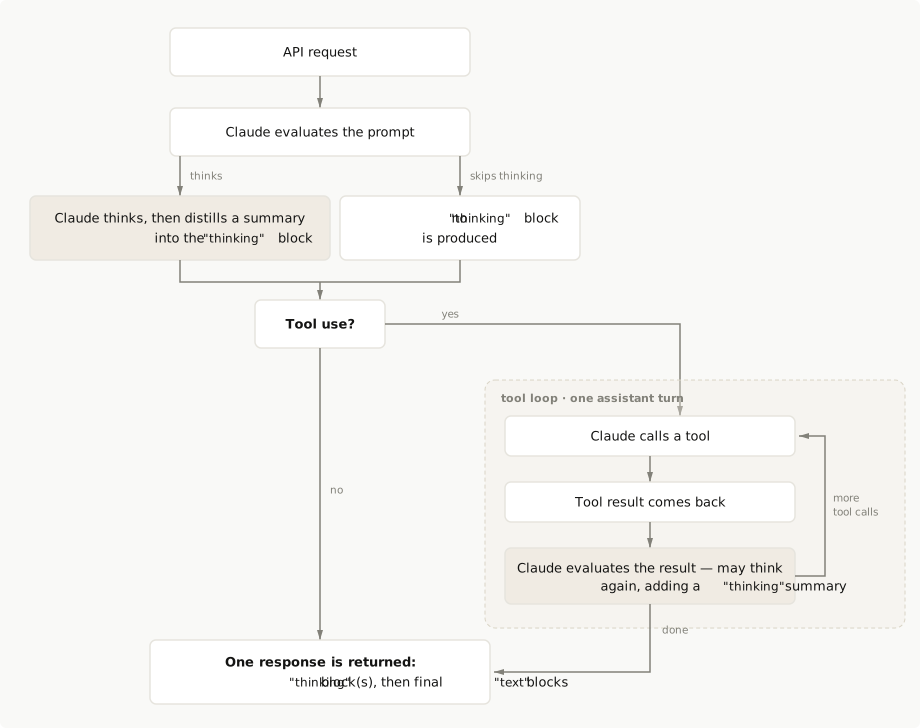
Whether Claude thinks on a given request, and how deeply, depends on your thinking configuration and the complexity of the request.
Here is what up-front thinking looks like in a response: one or more `thinking` content blocks arrive before the `text` blocks. The thinking block is still generated content, like the `text` block that follows it, but it is separated from the canonical response. Each thinking block also carries a `signature` field, an encrypted copy of the full reasoning that you pass back unchanged in multi-turn and tool-use conversations (see [Thinking encryption](https://platform.claude.com/docs/en/build-with-claude/thinking#thinking-encryption)):
```json
{
"content": [
{
"type": "thinking",
"thinking": "Let me break this down. The question has two parts, so I'll start with the simpler one and use its result to constrain the second...",
"signature": "WaUjzkypQ2mUEVM36O2Txu...."
},
{
"type": "text",
"text": "Based on my analysis..."
}
]
}
```
You don't always see this text, and what you see is never the raw chain of thought: the text in a thinking block is a [summary of Claude's reasoning](https://platform.claude.com/docs/en/build-with-claude/thinking#summarized-thinking). The `display` field on the thinking configuration controls whether that summary is returned at all: `"summarized"` returns it, while `"omitted"`, the default on many models, returns thinking blocks with an empty `thinking` field. Either way the block is billed the same and passed back the same in multi-turn conversations. See [Controlling thinking display](https://platform.claude.com/docs/en/build-with-claude/thinking#controlling-thinking-display) for per-model defaults and details.
If Claude uses tools, thinking can also appear between tool calls. See [Thinking with tool use](https://platform.claude.com/docs/en/build-with-claude/thinking#thinking-with-tool-use). For the full response format, see the [Messages API reference](https://platform.claude.com/docs/en/api/messages/create).
## Configuring thinking
On most models, thinking is on by default or one parameter away. The following table shows what each model does with each `thinking` value a request can send. A 400 error means the API rejects the request, and [Troubleshooting thinking](https://platform.claude.com/docs/en/build-with-claude/thinking-troubleshooting) has each error and its fix.
| Model | No `thinking` field | `"adaptive"` | `"enabled"` with `budget_tokens` | `"between_tools"` | `"disabled"` |
| --------------------- | ------------------- | ----------------- | -------------------------------- | ----------------------------------------------- | -------------------------------------- |
| Claude Opus 5.5 | Adaptive thinking | Adaptive thinking | 400 error | 400 error | 400 error |
| Claude Sonnet 5.5 | Adaptive thinking | Adaptive thinking | 400 error | Up-front thinking off at `high` effort or below | 400 error |
| Claude Haiku 5.5 | Adaptive thinking | Adaptive thinking | 400 error | 400 error | Thinking off at `high` effort or below |
| Claude Fable 5.1 | Adaptive thinking | Adaptive thinking | 400 error | 400 error | 400 error |
| Claude Mythos 5.1 | Adaptive thinking | Adaptive thinking | 400 error | 400 error | 400 error |
| Claude Fable 5 | Adaptive thinking | Adaptive thinking | 400 error | 400 error | 400 error |
| Claude Mythos 5 | Adaptive thinking | Adaptive thinking | 400 error | 400 error | 400 error |
| Claude Opus 5 | Adaptive thinking | Adaptive thinking | 400 error | 400 error | Thinking off at `high` effort or below |
| Claude Sonnet 5 | Adaptive thinking | Adaptive thinking | 400 error | 400 error | Thinking off |
| Claude Opus 4.8 | Thinking off | Adaptive thinking | 400 error | 400 error | Thinking off |
| Claude Opus 4.7 | Thinking off | Adaptive thinking | 400 error | 400 error | Thinking off |
| Claude Mythos Preview | Adaptive thinking | Adaptive thinking | Extended thinking | 400 error | 400 error |
| Claude Opus 4.6 | Thinking off | Adaptive thinking | Extended thinking (deprecated) | 400 error | Thinking off |
| Claude Sonnet 4.6 | Thinking off | Adaptive thinking | Extended thinking (deprecated) | 400 error | Thinking off |
| Claude Opus 4.5 | Thinking off | 400 error | Extended thinking | 400 error | Thinking off |
| Claude Sonnet 4.5 | Thinking off | 400 error | Extended thinking | 400 error | Thinking off |
| Claude Haiku 4.5 | Thinking off | 400 error | Extended thinking | 400 error | Thinking off |
In the table, "at `high` effort or below" means the request works at `low`, `medium`, and `high` effort and returns a 400 error at `xhigh` or `max`.
On Claude Opus 5.5, Claude Opus 5, Claude Sonnet 5.5, Claude Sonnet 5, Claude Fable 5.1, Claude Mythos 5.1, Claude Fable 5, Claude Mythos 5, Claude Mythos Preview, and Claude Haiku 5.5, thinking is already on and needs no configuration. `display` defaults to `"omitted"` on these models, so the thinking text is hidden until you opt in. Opt in with `thinking: {"type": "adaptive", "display": "summarized"}`, as the following examples do.
On Claude Opus 4.8, Claude Opus 4.7, Claude Opus 4.6, and Claude Sonnet 4.6, thinking is off until you set `thinking: {type: "adaptive"}`, which lets Claude determine when and how deeply to think based on the request. The same request, with the [model string](https://platform.claude.com/docs/en/models/overview) swapped, turns it on there. The following examples set `display: "summarized"` so the thinking text is visible, and use a roomy `max_tokens`:
```bash cURL
curl https://api.anthropic.com/v1/messages \
-H "x-api-key: $ANTHROPIC_API_KEY" \
-H "anthropic-version: 2023-06-01" \
-H "content-type: application/json" \
-d '{
"model": "claude-opus-5-5",
"max_tokens": 16000,
"thinking": {
"type": "adaptive",
"display": "summarized"
},
"messages": [
{
"role": "user",
"content": "What is the greatest common divisor of 1071 and 462?"
}
]
}'
```
```bash CLI
ant messages create \
--model claude-opus-5-5 \
--max-tokens 16000 \
--thinking '{type: adaptive, display: summarized}' \
--message '{role: user, content: "What is the greatest common divisor of 1071 and 462?"}' \
--transform content \
--format yaml
```
```python Python
client = anthropic.Anthropic()
response = client.messages.create(
model="claude-opus-5-5",
max_tokens=16000,
thinking={"type": "adaptive", "display": "summarized"},
messages=[
{
"role": "user",
"content": "What is the greatest common divisor of 1071 and 462?",
}
],
)
for block in response.content:
match block.type:
case "thinking":
print(f"\nThinking: {block.thinking}")
case "text":
print(f"\nResponse: {block.text}")
```
```typescript TypeScript
const client = new Anthropic();
const response = await client.messages.create({
model: "claude-opus-5-5",
max_tokens: 16000,
thinking: {
type: "adaptive",
display: "summarized"
},
messages: [
{
role: "user",
content: "What is the greatest common divisor of 1071 and 462?"
}
]
});
for (const block of response.content) {
switch (block.type) {
case "thinking":
console.log(`\nThinking: ${block.thinking}`);
break;
case "text":
console.log(`\nResponse: ${block.text}`);
break;
}
}
```
```csharp C#
AnthropicClient client = new();
var parameters = new MessageCreateParams
{
Model = Model.ClaudeOpus5_5,
MaxTokens = 16000,
Thinking = new ThinkingConfigAdaptive { Display = Display.Summarized },
Messages = [
new() {
Role = Role.User,
Content = "What is the greatest common divisor of 1071 and 462?"
}
]
};
var message = await client.Messages.Create(parameters);
foreach (var block in message.Content)
{
if (block.TryPickThinking(out ThinkingBlock? thinking))
{
Console.WriteLine($"\nThinking: {thinking.Thinking}");
}
else if (block.TryPickText(out TextBlock? text))
{
Console.WriteLine($"\nResponse: {text.Text}");
}
}
```
```go Go
client := anthropic.NewClient()
response, err := client.Messages.New(context.TODO(), anthropic.MessageNewParams{
Model: anthropic.ModelClaudeOpus5_5,
MaxTokens: 16000,
Thinking: anthropic.ThinkingConfigParamUnion{
OfAdaptive: &anthropic.ThinkingConfigAdaptiveParam{
Display: anthropic.ThinkingConfigAdaptiveDisplaySummarized,
},
},
Messages: []anthropic.MessageParam{
anthropic.NewUserMessage(anthropic.NewTextBlock("What is the greatest common divisor of 1071 and 462?")),
},
})
if err != nil {
log.Fatal(err)
}
for _, block := range response.Content {
switch v := block.AsAny().(type) {
case anthropic.ThinkingBlock:
fmt.Printf("\nThinking: %s", v.Thinking)
case anthropic.TextBlock:
fmt.Printf("\nResponse: %s", v.Text)
}
}
```
```java Java
import com.anthropic.models.messages.ThinkingConfigAdaptive;
void main() {
AnthropicClient client = AnthropicOkHttpClient.fromEnv();
MessageCreateParams params = MessageCreateParams.builder()
.model(Model.CLAUDE_OPUS_5_5)
.maxTokens(16000L)
.thinking(ThinkingConfigAdaptive.builder()
.display(ThinkingConfigAdaptive.Display.SUMMARIZED)
.build())
.addUserMessage("What is the greatest common divisor of 1071 and 462?")
.build();
Message response = client.messages().create(params);
response.content().forEach(block -> {
block.thinking().ifPresent(thinkingBlock ->
IO.println("\nThinking: " + thinkingBlock.thinking())
);
block.text().ifPresent(textBlock ->
IO.println("\nResponse: " + textBlock.text())
);
});
}
```
```php PHP
use Anthropic\Messages\TextBlock;
use Anthropic\Messages\ThinkingBlock;
$client = new Client();
$message = $client->messages->create(
maxTokens: 16000,
messages: [
[
'role' => 'user',
'content' => 'What is the greatest common divisor of 1071 and 462?'
]
],
model: 'claude-opus-5-5',
thinking: ['type' => 'adaptive', 'display' => 'summarized'],
);
foreach ($message->content as $block) {
switch (true) {
case $block instanceof ThinkingBlock:
echo "\nThinking: " . $block->thinking;
break;
case $block instanceof TextBlock:
echo "\nResponse: " . $block->text;
break;
}
}
```
```ruby Ruby
client = Anthropic::Client.new
message = client.messages.create(
model: "claude-opus-5-5",
max_tokens: 16000,
thinking: {
type: "adaptive",
# A plain hash like this one takes display:. The typed ThinkingConfigAdaptive class
# spells it display_ (trailing underscore) to avoid shadowing Ruby's Kernel#display.
# The request still sends display.
display: "summarized"
},
messages: [
{
role: "user",
content: "What is the greatest common divisor of 1071 and 462?"
}
]
)
message.content.each do |block|
case block
when Anthropic::Models::ThinkingBlock
puts "\nThinking: #{block.thinking}"
when Anthropic::Models::TextBlock
puts "\nResponse: #{block.text}"
end
end
```
Running the example prints the summarized thinking, then the answer:
```text Output wrap
Thinking: Use Euclidean algorithm.
1071 = 2*462 + 147
462 = 3*147 + 21
147 = 7*21 + 0
GCD = 21
Response: ## Finding GCD of 1071 and 462
I'll use the **Euclidean algorithm**, repeatedly dividing and taking remainders...
```
Thinking tokens count toward `max_tokens`, so set it high enough to leave room for both the thinking and the response text. See [Cost control](https://platform.claude.com/docs/en/build-with-claude/thinking-steering-and-cost#cost-control) on the steering page and [Thinking and the context window](https://platform.claude.com/docs/en/build-with-claude/thinking#thinking-and-the-context-window).
### Turning thinking off
On Claude Sonnet 5, where thinking is on by default, you can turn it off:
```bash cURL
curl https://api.anthropic.com/v1/messages \
-H "x-api-key: $ANTHROPIC_API_KEY" \
-H "anthropic-version: 2023-06-01" \
-H "content-type: application/json" \
-d '{
"model": "claude-sonnet-5",
"max_tokens": 4096,
"thinking": {"type": "disabled"},
"messages": [
{
"role": "user",
"content": "Summarize this article in one sentence."
}
]
}'
```
```bash CLI
ant messages create \
--model claude-sonnet-5 \
--max-tokens 4096 \
--thinking '{type: disabled}' \
--message '{role: user, content: "Summarize this article in one sentence."}'
```
```python Python
client = anthropic.Anthropic()
response = client.messages.create(
model="claude-sonnet-5",
max_tokens=4096,
thinking={"type": "disabled"},
messages=[{"role": "user", "content": "Summarize this article in one sentence."}],
)
```
```typescript TypeScript
const client = new Anthropic();
const response = await client.messages.create({
model: "claude-sonnet-5",
max_tokens: 4096,
thinking: { type: "disabled" },
messages: [{ role: "user", content: "Summarize this article in one sentence." }]
});
```
```csharp C#
AnthropicClient client = new();
var parameters = new MessageCreateParams
{
Model = Model.ClaudeSonnet5,
MaxTokens = 4096,
Thinking = new ThinkingConfigDisabled(),
Messages = [
new() {
Role = Role.User,
Content = "Summarize this article in one sentence."
}
]
};
var message = await client.Messages.Create(parameters);
```
```go Go
client := anthropic.NewClient()
response, err := client.Messages.New(context.TODO(), anthropic.MessageNewParams{
Model: anthropic.ModelClaudeSonnet5,
MaxTokens: 4096,
Thinking: anthropic.ThinkingConfigParamUnion{
OfDisabled: &anthropic.ThinkingConfigDisabledParam{},
},
Messages: []anthropic.MessageParam{
anthropic.NewUserMessage(anthropic.NewTextBlock("Summarize this article in one sentence.")),
},
})
if err != nil {
log.Fatal(err)
}
```
```java Java
import com.anthropic.models.messages.ThinkingConfigDisabled;
void main() {
AnthropicClient client = AnthropicOkHttpClient.fromEnv();
MessageCreateParams params = MessageCreateParams.builder()
.model(Model.CLAUDE_SONNET_5)
.maxTokens(4096L)
.thinking(ThinkingConfigDisabled.builder().build())
.addUserMessage("Summarize this article in one sentence.")
.build();
Message response = client.messages().create(params);
}
```
```php PHP
$client = new Client();
$message = $client->messages->create(
maxTokens: 4096,
messages: [
[
'role' => 'user',
'content' => 'Summarize this article in one sentence.'
]
],
model: 'claude-sonnet-5',
thinking: ['type' => 'disabled'],
);
```
```ruby Ruby
client = Anthropic::Client.new
message = client.messages.create(
model: "claude-sonnet-5",
max_tokens: 4096,
thinking: { type: "disabled" },
messages: [
{
role: "user",
content: "Summarize this article in one sentence."
}
]
)
```
Claude Opus 5 also has thinking on by default and accepts `thinking: {type: "disabled"}` at [effort](https://platform.claude.com/docs/en/build-with-claude/effort) `high` or below. At `xhigh` or `max` effort, thinking cannot be turned off: requests that combine `thinking: {type: "disabled"}` with those effort levels return a 400 error. This restriction is enforced on each request. With thinking disabled, Claude Opus 5 can occasionally emit tool calls as plain text or include internal XML tags in its visible output. See [Running with thinking disabled](https://platform.claude.com/docs/en/build-with-claude/prompt-engineering/prompting-claude-opus-5#running-with-thinking-disabled) for prompting mitigations.
Claude Sonnet 5.5 also has thinking on by default, and it rejects `thinking: {type: "disabled"}` with a 400 error. To turn off up-front thinking, send `thinking: {type: "between_tools"}` instead. It's the lowest thinking setting on Claude Sonnet 5.5, and it's accepted at [effort](https://platform.claude.com/docs/en/build-with-claude/effort) `high` or below. The model still returns its [progress updates between tool calls](https://platform.claude.com/docs/en/build-with-claude/thinking#progress-updates). Without tools, the response contains only text, as with `disabled` on Claude Sonnet 5. See [Running without up-front thinking](https://platform.claude.com/docs/en/build-with-claude/prompt-engineering/prompting-claude-sonnet-5-5#running-without-up-front-thinking) for prompting guidance.
Claude Haiku 5.5 also has thinking on by default and accepts `thinking: {type: "disabled"}` at [effort](https://platform.claude.com/docs/en/build-with-claude/effort) `high` or below. At `xhigh` or `max` effort, that combination returns a 400 error. To get less thinking, lower the effort level first. With thinking off, the model can skip a tool call it needs when you also request JSON output. A [per-message `output_config.effort`](https://platform.claude.com/docs/en/build-with-claude/effort#change-effort-mid-conversation-beta) that differs from the level in effect also returns a 400 error while thinking is off. See [Use effort to control thinking](https://platform.claude.com/docs/en/build-with-claude/prompt-engineering/prompting-claude-haiku-5-5#use-effort-to-control-thinking) and [Use adaptive thinking with JSON output and your own tools](https://platform.claude.com/docs/en/build-with-claude/prompt-engineering/prompting-claude-haiku-5-5#json-output-with-your-own-tools).
Claude Fable 5.1, Claude Mythos 5.1, Claude Fable 5, Claude Mythos 5, Claude Opus 5.5, and Claude Mythos Preview reject `thinking: {type: "disabled"}`. Thinking can't be turned off on these models.
To check whether a model accepts `"disabled"` before you send a request, read its `capabilities.thinking.types.disabled.supported` value from the Models API. [Using the Models API](https://platform.claude.com/docs/en/models/overview#using-the-models-api) describes the field.
If your model supports only extended thinking (see the [per-model configuration table](https://platform.claude.com/docs/en/build-with-claude/thinking-troubleshooting#supported-models)), configure it with `type: "enabled"` and a `budget_tokens` value instead. The [Extended thinking](https://platform.claude.com/docs/en/build-with-claude/extended-thinking) page covers that configuration. And if any thinking configuration comes back with a 400 error, [Troubleshooting thinking](https://platform.claude.com/docs/en/build-with-claude/thinking-troubleshooting) matches each error message to its fix.
## Reading thinking output
### Controlling thinking display
The `display` field on the thinking configuration controls how thinking content is returned in API responses. `display` works in both modes: set it alongside `type: "adaptive"` or `type: "enabled"`. It accepts these values:
* `"summarized"`: thinking blocks contain [summarized thinking](https://platform.claude.com/docs/en/build-with-claude/thinking#summarized-thinking) text, a readable summary of Claude's reasoning. This is the default on Claude Opus 4.6, Claude Sonnet 4.6, and earlier models.
* `"omitted"`: thinking blocks are returned with an empty `thinking` field. The `signature` field still carries the encrypted full thinking for multi-turn continuity (see [Thinking encryption](https://platform.claude.com/docs/en/build-with-claude/thinking#thinking-encryption)). This is the default on Claude Fable 5.1, Claude Mythos 5.1, Claude Fable 5, Claude Mythos 5, Claude Opus 5.5, Claude Opus 5, Claude Sonnet 5.5, Claude Sonnet 5, Claude Opus 4.8, Claude Opus 4.7, [Claude Mythos Preview](https://anthropic.com/glasswing), and Claude Haiku 5.5.
* `"updates"` (beta): reasoning blocks are returned with an empty `thinking` field, as with `"omitted"`, and the short [progress updates](https://platform.claude.com/docs/en/build-with-claude/thinking#progress-updates) some models write between tool calls come back as readable text. Requires the beta header `thinking-display-updates-2026-08-18`.
Set `display: "omitted"` when your application doesn't surface thinking content to users. The primary benefit is faster time-to-first-text-token when streaming: the server skips streaming thinking tokens entirely and delivers only the signature, so the final text response begins streaming sooner.
With `display: "omitted"`, the response contains `thinking` blocks with an empty `thinking` field:
```json Output
{
"content": [
{
"type": "thinking",
"thinking": "",
"signature": "EosnCkYICxIMMb3LzNrMu..."
},
{
"type": "text",
"text": "The answer is 12,231."
}
]
}
```
Keep the following in mind when working with omitted thinking:
* You're still charged for the full thinking tokens. Omitting reduces latency, not cost.
* If you pass thinking blocks back in multi-turn conversations, pass them unchanged. The server decrypts the `signature` to reconstruct the original thinking for prompt construction (see [Preserving thinking blocks](https://platform.claude.com/docs/en/build-with-claude/thinking#preserving-thinking-blocks)). Any text you place in the `thinking` field of a round-tripped omitted block is ignored.
* `display` is invalid with `thinking.type: "disabled"` (there is nothing to display) and with `thinking.type: "between_tools"` (Claude Sonnet 5.5 only), which accepts no other field. With `between_tools`, progress updates still come back with summary text, as they do under `display: "updates"` (see [Progress updates](https://platform.claude.com/docs/en/build-with-claude/thinking#progress-updates)).
* When using `thinking.type: "adaptive"` and the model skips thinking for a simple request, no thinking block is produced regardless of `display`.
* When streaming with `display: "omitted"`, no thinking text is streamed. Each thinking block streams a `thinking_delta` with an empty `thinking` string, then its `signature_delta`. With `display: "updates"`, only [progress-update blocks](https://platform.claude.com/docs/en/build-with-claude/thinking#progress-updates) stream `thinking_delta` events that carry text. See [Streaming thinking](https://platform.claude.com/docs/en/build-with-claude/thinking#streaming-thinking) for the event sequence.
The `signature` field is identical whichever `display` value you set. Switching `display` values between turns in a conversation is supported.
### Summarized thinking
When `display` is `"summarized"`, the thinking text you receive is a summary of Claude's full thinking process rather than the raw chain of thought. Summarized thinking provides the full intelligence benefits of thinking while preventing misuse. No `display` setting returns the raw chain of thought.
Keep the following in mind when working with summarized thinking:
* You're charged for the full thinking tokens generated by the original request, not the summary tokens. The billed output token count does not match the count of tokens you see in the response.
* On Claude Opus 4.6, Claude Sonnet 4.6, and earlier models, the first few lines of thinking output are more verbose, providing detailed reasoning that's particularly helpful for prompt engineering purposes. [Claude Mythos Preview](https://anthropic.com/glasswing) summarizes from the first token, so its thinking blocks do not show this verbose preamble.
* Summarization preserves the key ideas of Claude's thinking process with minimal added latency, so summaries can stream as they arrive.
* Summarization is processed by a different model from the one you target in your requests. The thinking model does not see the summarized output.
* As Anthropic seeks to improve the thinking feature, summarization behavior is subject to change.
In rare cases where you need access to full thinking output, [contact Anthropic sales](mailto:sales@anthropic.com).
To see the model's reasoning, read the `thinking` blocks rather than prompting for reasoning in the response text. On Claude Fable 5.1, Claude Opus 5.5, Claude Opus 5, Claude Sonnet 5.5, and Claude Fable 5, a request that attempts to elicit the model's internal reasoning as part of the response text may be refused with `stop_details.category: "reasoning_extraction"`. See [Refusal categories](https://platform.claude.com/docs/en/build-with-claude/refusals-and-fallback#refusal-response) for the field reference and [Keep reasoning in thinking blocks](https://platform.claude.com/docs/en/build-with-claude/refusals-and-fallback#keep-reasoning-in-thinking-blocks) for what to ask for instead.
### Streaming thinking
Thinking works with [streaming](https://platform.claude.com/docs/en/build-with-claude/streaming). Thinking blocks stream as `thinking_delta` events inside `content_block_delta` events, followed by a single `signature_delta` event just before the block's `content_block_stop`. Text blocks stream afterward as usual.
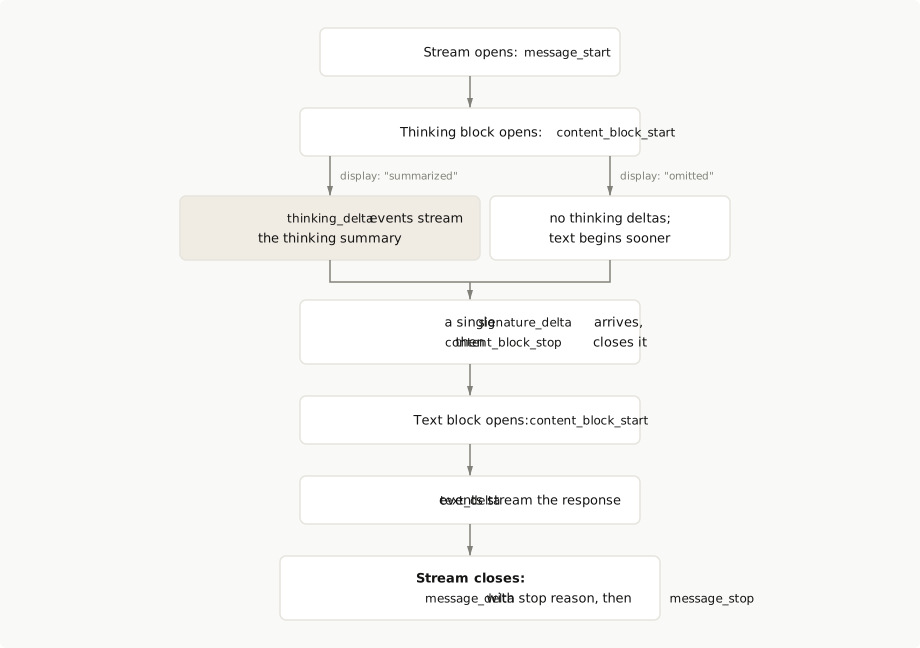
The following examples stream a response with adaptive thinking, printing thinking and text deltas as they arrive:
```bash cURL
curl https://api.anthropic.com/v1/messages \
-H "x-api-key: $ANTHROPIC_API_KEY" \
-H "anthropic-version: 2023-06-01" \
-H "content-type: application/json" \
-d '{
"model": "claude-opus-5-5",
"max_tokens": 16000,
"stream": true,
"thinking": {
"type": "adaptive",
"display": "summarized"
},
"messages": [
{
"role": "user",
"content": "What is the greatest common divisor of 1071 and 462?"
}
]
}'
```
```bash CLI
ant messages create \
--model claude-opus-5-5 \
--max-tokens 16000 \
--thinking '{type: adaptive, display: summarized}' \
--message '{role: user, content: "What is the greatest common divisor of 1071 and 462?"}' \
--stream \
--format jsonl
```
```python Python
client = anthropic.Anthropic()
with client.messages.stream(
model="claude-opus-5-5",
max_tokens=16000,
thinking={"type": "adaptive", "display": "summarized"},
messages=[
{
"role": "user",
"content": "What is the greatest common divisor of 1071 and 462?",
}
],
) as stream:
for event in stream:
match event.type:
case "content_block_start":
print(f"\nStarting {event.content_block.type} block...")
case "content_block_delta":
delta = event.delta
match delta.type:
case "thinking_delta":
print(delta.thinking, end="", flush=True)
case "text_delta":
print(delta.text, end="", flush=True)
```
```typescript TypeScript
const client = new Anthropic();
const stream = client.messages.stream({
model: "claude-opus-5-5",
max_tokens: 16000,
thinking: { type: "adaptive", display: "summarized" },
messages: [{ role: "user", content: "What is the greatest common divisor of 1071 and 462?" }]
});
for await (const event of stream) {
switch (event.type) {
case "content_block_start":
console.log(`\nStarting ${event.content_block.type} block...`);
break;
case "content_block_delta":
switch (event.delta.type) {
case "thinking_delta":
process.stdout.write(event.delta.thinking);
break;
case "text_delta":
process.stdout.write(event.delta.text);
break;
}
break;
}
}
```
```csharp C#
AnthropicClient client = new();
var parameters = new MessageCreateParams
{
Model = Model.ClaudeOpus5_5,
MaxTokens = 16000,
Thinking = new ThinkingConfigAdaptive { Display = Display.Summarized },
Messages = [new() { Role = Role.User, Content = "What is the greatest common divisor of 1071 and 462?" }]
};
await foreach (var rawEvent in client.Messages.CreateStreaming(parameters))
{
if (rawEvent.TryPickContentBlockStart(out var start))
{
Console.WriteLine($"\nStarting {start.ContentBlock.Type} block...");
}
else if (rawEvent.TryPickContentBlockDelta(out var delta))
{
if (delta.Delta.TryPickThinking(out var thinkingDelta))
{
Console.Write(thinkingDelta.Thinking);
}
else if (delta.Delta.TryPickText(out var textDelta))
{
Console.Write(textDelta.Text);
}
}
}
```
```go Go
client := anthropic.NewClient()
stream := client.Messages.NewStreaming(context.TODO(), anthropic.MessageNewParams{
Model: anthropic.ModelClaudeOpus5_5,
MaxTokens: 16000,
Thinking: anthropic.ThinkingConfigParamUnion{
OfAdaptive: &anthropic.ThinkingConfigAdaptiveParam{
Display: anthropic.ThinkingConfigAdaptiveDisplaySummarized,
},
},
Messages: []anthropic.MessageParam{
anthropic.NewUserMessage(anthropic.NewTextBlock("What is the greatest common divisor of 1071 and 462?")),
},
})
for stream.Next() {
event := stream.Current()
switch eventVariant := event.AsAny().(type) {
case anthropic.ContentBlockStartEvent:
fmt.Printf("\nStarting %s block...\n", eventVariant.ContentBlock.Type)
case anthropic.ContentBlockDeltaEvent:
switch deltaVariant := eventVariant.Delta.AsAny().(type) {
case anthropic.ThinkingDelta:
fmt.Print(deltaVariant.Thinking)
case anthropic.TextDelta:
fmt.Print(deltaVariant.Text)
}
}
}
if err := stream.Err(); err != nil {
log.Fatal(err)
}
```
```java Java
import com.anthropic.models.messages.ThinkingConfigAdaptive;
void main() {
AnthropicClient client = AnthropicOkHttpClient.fromEnv();
MessageCreateParams params = MessageCreateParams.builder()
.model(Model.CLAUDE_OPUS_5_5)
.maxTokens(16000L)
.thinking(ThinkingConfigAdaptive.builder()
.display(ThinkingConfigAdaptive.Display.SUMMARIZED)
.build())
.addUserMessage("What is the greatest common divisor of 1071 and 462?")
.build();
try (var streamResponse = client.messages().createStreaming(params)) {
streamResponse.stream().forEach(event -> {
switch (event.type().value()) {
case CONTENT_BLOCK_START -> {
var startEvent = event.asContentBlockStart();
var block = startEvent.contentBlock();
switch (block.type().value()) {
case THINKING -> IO.println("\nStarting thinking block...");
case TEXT -> IO.println("\nStarting text block...");
}
}
case CONTENT_BLOCK_DELTA -> {
var deltaEvent = event.asContentBlockDelta();
deltaEvent.delta().thinking().ifPresent(td ->
IO.print(td.thinking())
);
deltaEvent.delta().text().ifPresent(td ->
IO.print(td.text())
);
}
}
});
}
}
```
```php PHP
use Anthropic\Messages\RawContentBlockDeltaEvent;
use Anthropic\Messages\RawContentBlockStartEvent;
use Anthropic\Messages\TextDelta;
use Anthropic\Messages\ThinkingDelta;
$client = new Client();
$stream = $client->messages->createStream(
maxTokens: 16000,
messages: [
['role' => 'user', 'content' => 'What is the greatest common divisor of 1071 and 462?']
],
model: 'claude-opus-5-5',
thinking: ['type' => 'adaptive', 'display' => 'summarized'],
);
foreach ($stream as $event) {
switch (true) {
case $event instanceof RawContentBlockStartEvent:
echo "\nStarting {$event->contentBlock->type} block...\n";
break;
case $event instanceof RawContentBlockDeltaEvent:
switch (true) {
case $event->delta instanceof ThinkingDelta:
echo $event->delta->thinking;
break;
case $event->delta instanceof TextDelta:
echo $event->delta->text;
break;
}
break;
}
}
```
```ruby Ruby
client = Anthropic::Client.new
stream = client.messages.stream(
model: "claude-opus-5-5",
max_tokens: 16000,
# A plain hash like this one takes display:. The typed ThinkingConfigAdaptive class
# spells it display_ (trailing underscore) to avoid shadowing Ruby's Kernel#display.
# The request still sends display.
thinking: { type: "adaptive", display: "summarized" },
messages: [
{ role: "user", content: "What is the greatest common divisor of 1071 and 462?" }
]
)
stream.each do |event|
case event
when Anthropic::Streaming::ThinkingEvent
print event.thinking
when Anthropic::Streaming::TextEvent
print event.text
end
end
```
To reassemble complete thinking blocks with their signatures after streaming, use your SDK's message-accumulation helper, `stream.get_final_message()` (typescript: `stream.finalMessage()`; ruby: `stream.accumulated_message`; csharp: `.Aggregate()`; go: `message.Accumulate(event)`; java, php: `MessageAccumulator`), instead of concatenating deltas yourself.
```sse Output
event: message_start
data: {"type": "message_start", "message": {"id": "msg_01...", "type": "message", "role": "assistant", "content": [], "model": "claude-opus-5-5", "stop_reason": null, "stop_sequence": null}}
event: content_block_start
data: {"type": "content_block_start", "index": 0, "content_block": {"type": "thinking", "thinking": "", "signature": ""}}
event: content_block_delta
data: {"type": "content_block_delta", "index": 0, "delta": {"type": "thinking_delta", "thinking": "I need to find the GCD of 1071 and 462 using the Euclidean algorithm.\n\n1071 = 2 × 462 + 147"}}
event: content_block_delta
data: {"type": "content_block_delta", "index": 0, "delta": {"type": "thinking_delta", "thinking": "\n462 = 3 × 147 + 21\n147 = 7 × 21 + 0\n\nSo GCD(1071, 462) = 21"}}
// Additional thinking deltas...
event: content_block_delta
data: {"type": "content_block_delta", "index": 0, "delta": {"type": "signature_delta", "signature": "EqQBCgIYAhIM1gbcDa9GJwZA2b..."}}
event: content_block_stop
data: {"type": "content_block_stop", "index": 0}
event: content_block_start
data: {"type": "content_block_start", "index": 1, "content_block": {"type": "text", "text": ""}}
event: content_block_delta
data: {"type": "content_block_delta", "index": 1, "delta": {"type": "text_delta", "text": "The greatest common divisor of 1071 and 462 is **21**."}}
// Additional text deltas...
event: content_block_stop
data: {"type": "content_block_stop", "index": 1}
event: message_delta
data: {"type": "message_delta", "delta": {"stop_reason": "end_turn", "stop_sequence": null}}
event: message_stop
data: {"type": "message_stop"}
```
When `display: "omitted"` is set, the thinking block opens, a `thinking_delta` with an empty `thinking` string arrives, a single `signature_delta` follows, and the block closes. Text streaming begins immediately after:
```sse Output
event: content_block_start
data: {"type":"content_block_start","index":0,"content_block":{"type":"thinking","thinking":"","signature":""}}
event: content_block_delta
data: {"type":"content_block_delta","index":0,"delta":{"type":"thinking_delta","thinking":""}}
event: content_block_delta
data: {"type":"content_block_delta","index":0,"delta":{"type":"signature_delta","signature":"EosnCkYICxIMMb3LzNrMu..."}}
event: content_block_stop
data: {"type":"content_block_stop","index":0}
event: content_block_start
data: {"type":"content_block_start","index":1,"content_block":{"type":"text","text":""}}
```
With `display: "updates"` (beta), reasoning blocks stream as they do under `"omitted"`. Each [progress-update block](https://platform.claude.com/docs/en/build-with-claude/thinking#progress-updates) streams its text as `thinking_delta` events before the `tool_use` block it introduces. A pause of several seconds before the progress-update block opens is normal:
```sse Output
event: content_block_start
data: {"type":"content_block_start","index":1,"content_block":{"type":"thinking","thinking":"","signature":""}}
event: content_block_delta
data: {"type":"content_block_delta","index":1,"delta":{"type":"thinking_delta","thinking":"Confirmed the retry path never refreshes the expired token. Editing auth.py to add the refresh call."}}
event: content_block_delta
data: {"type":"content_block_delta","index":1,"delta":{"type":"signature_delta","signature":"Es8CCkYICxIM..."}}
event: content_block_stop
data: {"type":"content_block_stop","index":1}
event: content_block_start
data: {"type":"content_block_start","index":2,"content_block":{"type":"tool_use","id":"toolu_01D7FLrfh4GYq7yT1ULFeyMV","name":"edit_file","input":{}}}
```
Under `"updates"`, treat a block as a progress update as soon as one of its `thinking_delta` events carries non-empty text.
When using streaming with thinking enabled, you might notice that text sometimes arrives in larger chunks alternating with smaller, token-by-token delivery. This is expected behavior, especially for thinking content.
The streaming system processes content in batches, which can delay and group streaming events into this "chunky" delivery pattern.
For general streaming mechanics, see [Streaming Messages](https://platform.claude.com/docs/en/build-with-claude/streaming).
## Thinking and effort
The `thinking` parameter controls whether Claude thinks in [thinking blocks](https://platform.claude.com/docs/en/build-with-claude/thinking) before answering; the `effort` parameter controls how much work Claude puts into the whole response, which in adaptive mode includes how often and how deeply it thinks. Don't pass `adaptive` as an `effort` value: `adaptive` is a thinking mode, not an effort level.
To learn what each effort level does to thinking behavior, see the [per-level thinking behavior table](https://platform.claude.com/docs/en/build-with-claude/thinking-steering-and-cost#effort-levels) on the [Steering thinking](https://platform.claude.com/docs/en/build-with-claude/thinking-steering-and-cost) page. The [Effort](https://platform.claude.com/docs/en/build-with-claude/effort) page documents the parameter itself, including which levels each model supports. On Claude Opus 4.5, the only extended-thinking-only model that supports effort, effort composes with `budget_tokens`. See [Budget rules and tuning](https://platform.claude.com/docs/en/build-with-claude/extended-thinking#budget-rules-and-tuning).
With the two controls separated this way, pick the one that matches your goal:
* **Lower cost or latency on a thinking-enabled workload:** lower `effort` first. It scales the whole response down, thinking included.
* **Claude is thinking too rarely or too shallowly:** raise `effort`, or see [Steering how often Claude thinks](https://platform.claude.com/docs/en/build-with-claude/thinking-steering-and-cost#tuning-thinking-behavior) on the steering page.
* **You need thinking fully off:** use `thinking: {type: "disabled"}` on models that allow it (see the [per-model configuration table](https://platform.claude.com/docs/en/build-with-claude/thinking-troubleshooting#supported-models)). Claude Sonnet 5.5 rejects `"disabled"`. Its lowest setting is `thinking: {type: "between_tools"}`, which turns off up-front thinking.
* **You need a hard ceiling on spend:** use `max_tokens`. Effort is soft guidance. `max_tokens` is a strict limit.
## Thinking with tool use
Thinking works alongside [tool use](https://platform.claude.com/docs/en/agents-and-tools/tool-use/overview), letting Claude reason through tool selection and process tool results. Two constraints apply:
1. **Tool choice limitation (manual mode):** tool use with manual extended thinking (`thinking: {type: "enabled"}`) only supports `tool_choice: {"type": "auto"}` (the default) or `tool_choice: {"type": "none"}`. Using `tool_choice: {"type": "any"}` or `tool_choice: {"type": "tool", "name": "..."}` results in an error because these options force tool use, which is incompatible with manual extended thinking. Adaptive thinking, including on models where thinking is on by default, supports forced tool use, except on Claude Opus 5.5, Claude Sonnet 5.5, Claude Fable 5.1, and Claude Mythos 5.1 (see [Response prefill and forced tool use](https://platform.claude.com/docs/en/build-with-claude/thinking#limits-and-feature-compatibility)). Where forced tool use is accepted, the response starts with the tool call and has no `thinking` block.
2. **Preserving thinking blocks:** when you return tool results, you must pass the thinking blocks from the assistant message back to the API, complete and unmodified. See [Preserving thinking blocks](https://platform.claude.com/docs/en/build-with-claude/thinking#preserving-thinking-blocks).
**A tool-use loop is one assistant turn.** From the model's perspective, an assistant turn doesn't complete until Claude finishes its full response, which may include multiple tool calls and results. This whole sequence is a single assistant turn:
```text wrap
User: "What's the weather in Paris?"
Assistant: [thinking] + [tool_use: get_weather]
User: [tool_result: "20°C, sunny"]
Assistant: [text: "The weather in Paris is 20°C and sunny"]
```
The entire turn runs in a single thinking mode: you can't toggle thinking in the middle of a turn, including during the tool-use loop. In extended (manual) mode, the API additionally enforces that the final assistant turn of a thinking-enabled request begins with a thinking block. Adaptive mode relaxes this: no assistant turn needs to start with one.
**Mid-turn conflicts degrade gracefully.** If you toggle thinking mid-turn (for example, between sending a tool call and returning its result), the API doesn't error. Instead, it silently disables thinking for that request. To preserve model quality, the API may strip thinking blocks that would create an invalid turn structure, or disable thinking when the conversation history is incompatible with thinking being enabled. To confirm whether thinking was active, check for the presence of `thinking` blocks in the response.
**Toggle between turns, not within them.** Plan your thinking strategy at the start of each turn. Complete the assistant turn, then change the thinking configuration for the next one:
```text wrap
User: "What's the weather?"
Assistant: [tool_use] (thinking disabled)
User: [tool_result]
Assistant: [text: "It's sunny"]
User: "What about tomorrow?"
Assistant: [thinking] + [text: "..."] (thinking enabled - new turn)
```
Toggling thinking modes also invalidates prompt caching. See [Thinking and prompt caching](https://platform.claude.com/docs/en/build-with-claude/thinking#thinking-and-prompt-caching).
### Preserving thinking blocks
When Claude invokes a tool, it pauses construction of its response to await external information. When you return the tool result, Claude continues building that same response, so its earlier reasoning must still be present. Pass every `thinking` block back to the API complete and unmodified, alongside the `tool_use` block it accompanied. This matters for two reasons:
1. **Reasoning continuity:** the thinking blocks capture the step-by-step reasoning that led to the tool requests. Including them lets Claude continue reasoning from where it left off.
2. **Context maintenance:** tool results appear as user messages in the API structure, but they're part of one continuous reasoning flow. Preserving thinking blocks maintains that flow across API calls.
In short:
* **Required:** within a tool-use turn, pass thinking blocks back.
* **Recommended:** across turns, pass everything back.
* **Allowed:** outside tool use, omit prior turns' thinking.
You don't need to prune old thinking yourself. Pass all thinking blocks back in multi-turn conversations, and the API automatically filters them, keeps the blocks needed to preserve the model's reasoning, and bills input tokens only for the blocks actually shown to Claude. Which prior-turn blocks are kept is per-model. See [Thinking block preservation by model](https://platform.claude.com/docs/en/build-with-claude/thinking#thinking-block-preservation-by-model). To override the default, use the [`clear_thinking_20251015` context-editing strategy](https://platform.claude.com/docs/en/build-with-claude/context-editing#thinking-block-clearing).
Within the latest assistant message, the sequence of consecutive `thinking` blocks must match what the model generated in the original request: you can't rearrange, edit, or partially drop them. This includes [`redacted_thinking` blocks](https://platform.claude.com/docs/en/build-with-claude/thinking#redacted-thinking-blocks).
Modified thinking blocks are rejected with a 400 error. See [A 400 error says thinking blocks cannot be modified](https://platform.claude.com/docs/en/build-with-claude/thinking-troubleshooting#error-thinking-blocks-modified) for the exact message, the common causes, and the fix. The one exception: text placed in the empty `thinking` field of an [omitted](https://platform.claude.com/docs/en/build-with-claude/thinking#controlling-thinking-display) block is ignored rather than rejected.
For a complete two-turn walkthrough with code in every SDK, see [Thinking in tool and multi-turn workflows](https://platform.claude.com/docs/en/build-with-claude/thinking-tool-workflows#two-turn-tool-use-round-trip). It defines a tool, receives a thinking-plus-tool-use response, and echoes the assistant turn back with the tool result.
### Interleaved thinking
Interleaved thinking lets Claude think between tool calls, reasoning about each tool result before acting on it. With interleaved thinking, Claude can:
* Reason about the results of a tool call before determining what to do next
* Chain multiple tool calls with reasoning steps in between
* Make more nuanced decisions based on intermediate results
Consecutive tool calls do not require interleaved thinking. Claude can chain tool calls with or without interleaved thinking. Interleaving changes where thinking blocks appear between tool calls, not whether tool calls can chain.
With adaptive thinking, interleaved thinking is automatic on every model that supports adaptive thinking. No beta header is needed. On Claude Fable 5.1, Claude Mythos 5.1, Claude Fable 5, Claude Mythos 5, Claude Mythos Preview, Claude Opus 5.5, Claude Opus 5, Claude Sonnet 5.5, Claude Opus 4.8, and Claude Opus 4.7, reasoning between tool calls always appears in thinking blocks. Claude Haiku 4.5 does not support interleaved thinking. On models using manual extended thinking, interleaving requires a beta header and changes how the thinking budget is counted. [Interleaved thinking in manual mode](https://platform.claude.com/docs/en/build-with-claude/extended-thinking#interleaved-thinking) covers the per-model rules and platform-specific header behavior.
With interleaved thinking, the thinking allocation can span the entire assistant turn rather than a single response. Interleaved thinking is only supported for [tools used through the Messages API](https://platform.claude.com/docs/en/agents-and-tools/tool-use/overview).
For a worked comparison showing what interleaved thinking changes in a two-tool workflow, see [How interleaved thinking changes the flow](https://platform.claude.com/docs/en/build-with-claude/thinking-tool-workflows#how-interleaved-thinking-changes-the-flow).
### Progress updates between tool calls
On Claude Fable 5.1, Claude Mythos 5.1, Claude Opus 5.5, Claude Sonnet 5.5, and Claude Fable 5, the model can write a progress update between tool calls. A progress update is a note on what the model just found and what it's about to do next, written for the person watching the agent rather than as reasoning. Each one comes back as its own `thinking` block with its own `signature`, separate from any reasoning block at the same point. It sits immediately before the `tool_use` or `server_tool_use` block it introduces. At most one progress update precedes each tool call, and the model can skip any of them. Progress updates aren't [interleaved thinking](https://platform.claude.com/docs/en/build-with-claude/thinking#interleaved-thinking): they appear whether or not reasoning blocks appear between tool calls, and a response can contain both.
What a progress-update block contains depends on [`display`](https://platform.claude.com/docs/en/build-with-claude/thinking#controlling-thinking-display):
| `display` | Reasoning blocks | Progress-update blocks |
| ----------------------------------------- | ---------------------- | -------------------------------------------------------- |
| `"omitted"` (the default on these models) | Empty `thinking` field | Empty `thinking` field |
| `"updates"` (beta) | Empty `thinking` field | Summary text |
| `"summarized"` | Summary text | Summary text, not distinguishable from a reasoning block |
On Claude Sonnet 5.5, the lowest thinking setting is `thinking: {type: "between_tools"}`. It turns off up-front thinking, and each progress update comes back with its summary text, as it would under `display: "updates"`. `between_tools` is accepted only at [effort](https://platform.claude.com/docs/en/build-with-claude/effort) `high` or below. At `xhigh` or `max`, a request with it returns a 400 error. `between_tools` takes no other field: `display`, `budget_tokens`, or `block_binding` sent with it returns a 400 error. The setting needs no beta header and works on every platform that offers Claude Sonnet 5.5. Pass the blocks back unchanged: a progress-update block you send back gives the model the full note it wrote, not the summary.
Use `display: "updates"` for an agent interface that keeps reasoning hidden and shows the user a status line at each step. Under it, any `thinking` block with non-empty text is a progress update, so render those and nothing else. It's in beta and requires the beta header `thinking-display-updates-2026-08-18` (to send it on Amazon Bedrock, Google Cloud, or Microsoft Foundry, see [Beta features on other platforms](https://platform.claude.com/docs/en/api/beta-headers#beta-features-on-other-platforms)). Without it, the value is rejected with the same 400 `invalid_request_error` as an unknown `display` value.
```json
{
"model": "claude-fable-5-1",
"max_tokens": 16000,
"thinking": { "type": "adaptive", "display": "updates" },
"tools": [
{
"name": "edit_file",
"description": "Replace the contents of a file in the repository.",
"input_schema": {
"type": "object",
"properties": {
"path": { "type": "string" },
"content": { "type": "string" }
},
"required": ["path", "content"]
}
}
],
"messages": [
{
"role": "user",
"content": "The login test fails after an hour of uptime. Find out why and fix it."
}
]
}
```
Under `"updates"`, the start of the response that follows a `tool_result` looks like this. The first block is reasoning and stays empty, as it would under `"omitted"`. The second carries text, so it's a progress update. Under `"summarized"` both blocks carry text, and under `"omitted"` both are empty.
```json Output
{
"content": [
{
"type": "thinking",
"thinking": "",
"signature": "EqMBCkYICxIM..."
},
{
"type": "thinking",
"thinking": "Confirmed the retry path never refreshes the expired token. Editing auth.py to add the refresh call.",
"signature": "Es8CCkYICxIM..."
},
{
"type": "tool_use",
"id": "toolu_01D7FLrfh4GYq7yT1ULFeyMV",
"name": "edit_file",
"input": { "path": "auth.py", "content": "..." }
}
]
}
```
Keep the following in mind when working with progress updates:
* Pass progress-update blocks back unchanged with the rest of the assistant turn, like any other `thinking` block.
* The text you receive is a summary of the progress update, normally a sentence or two. Don't rely on its length. The progress update counts toward `usage.output_tokens` at its full length, not the summary's.
* A progress-update block can come back with an empty `thinking` field under any `display` value. Render nothing for an empty block. Under `"updates"` it looks the same as an empty reasoning block and needs no separate handling.
* When a response stops on `max_tokens`, `model_context_window_exceeded`, or `stop_sequence` soon after a tool call or tool result, its last block can be a progress-update block standing in for the work the model hadn't finished. Under `"updates"` and `"summarized"` its text is exactly `This part of the response was interrupted before it finished.` and you can show it like any other update. Under `"omitted"` it's empty. To continue, pass the assistant turn back unchanged and append a new `user` message (with a `tool_result` for each `tool_use` block in that turn).
* When [streaming](https://platform.claude.com/docs/en/build-with-claude/thinking#streaming-thinking), expect a pause of several seconds before a progress-update block opens. See the `"updates"` trace in [Streaming thinking](https://platform.claude.com/docs/en/build-with-claude/thinking#streaming-thinking).
* These models write fewer progress updates at higher [effort](https://platform.claude.com/docs/en/build-with-claude/effort) and in long tool chains. If your interface depends on them, see [Ask for user-facing progress updates](https://platform.claude.com/docs/en/build-with-claude/prompt-engineering/prompting-claude-fable-5-1#ask-for-user-facing-progress-updates) or, for Claude Opus 5.5, [User-facing progress updates](https://platform.claude.com/docs/en/build-with-claude/prompt-engineering/prompting-claude-opus-5-5#user-facing-progress-updates). For Claude Sonnet 5.5, see [User-facing progress updates](https://platform.claude.com/docs/en/build-with-claude/prompt-engineering/prompting-claude-sonnet-5-5#user-facing-progress-updates).
### Thinking block preservation by model
Whether thinking blocks from previous assistant turns stay in context by default depends on the model:
* **Keep all prior turns:** Claude Opus 4.5 and later Opus models, Claude Sonnet 4.6 and later Sonnet models, Claude Haiku 5.5, Claude Fable 5.1, Claude Mythos 5.1, Claude Fable 5, Claude Mythos 5, and Claude Mythos Preview.
* **Keep the last turn only:** earlier Opus and Sonnet models, and all Haiku models through Claude Haiku 4.5. When you pass older thinking blocks back, the API strips them automatically. You don't need to remove them yourself.
Preservation brings two benefits:
* **Cache optimization:** preserved thinking blocks enable cache hits during tool use, as they are passed back with tool results and cached incrementally across the assistant turn, resulting in token savings in multistep workflows.
* **No intelligence impact:** preserving thinking blocks has no negative effect on model performance.
The tradeoff is context usage: long conversations consume more context space on keep-all models, because retained thinking blocks count as input like any other conversation history (see [Thinking and the context window](https://platform.claude.com/docs/en/build-with-claude/thinking#thinking-and-the-context-window)). The behavior is automatic in both regimes. No code changes or beta headers are required, and you should keep passing complete, unmodified thinking blocks back as described in [Preserving thinking blocks](https://platform.claude.com/docs/en/build-with-claude/thinking#preserving-thinking-blocks). To override the default in either direction, use [thinking block clearing](https://platform.claude.com/docs/en/build-with-claude/context-editing#thinking-block-clearing).
**Switching models mid-conversation.** Keep passing thinking blocks back unchanged when you switch models, for example after a [classifier refusal fallback](https://platform.claude.com/docs/en/build-with-claude/refusals-and-fallback). A thinking block is readable only by the model that produced it and certain other models, and the API ignores or drops the blocks the target model can't read. On Claude Fable 5.1 and Claude Mythos 5.1 the direction matters: they read earlier models' thinking blocks, and only the two of them read each other's, so switching to them keeps the conversation's reasoning and switching from them to any other model drops it (see [how dropped blocks are billed and reported](https://platform.claude.com/docs/en/build-with-claude/preserved-thinking#switching-models)). Claude Opus 5.5 reads Claude Opus 5's thinking blocks and those of earlier Opus, Sonnet, and Haiku models, and, on the Claude API and Google Cloud, of Claude Haiku 5.5, but not those of the Claude Fable and Claude Mythos models; on the Claude API, Claude Fable 5.1 and Claude Mythos 5.1 read Claude Opus 5.5's blocks. A switch from Claude Opus 5.5 up to Claude Fable 5.1 on the Claude API keeps the earlier turns' reasoning; a switch from Claude Fable 5.1 to Claude Opus 5.5 drops it. Claude Sonnet 5.5 reads thinking blocks from Claude Sonnet 5, Claude Opus 4.8, Claude Haiku 4.5, and earlier models, and, on the Claude API and Google Cloud, from Claude Haiku 5.5, but not from Claude Opus 5, Claude Opus 5.5, or any Claude Fable or Claude Mythos model. On the Claude API and Google Cloud, Claude Opus 5.5 reads Claude Sonnet 5.5's blocks and no other model does: a switch from Claude Sonnet 5.5 up to Claude Opus 5.5 on the Claude API and Google Cloud keeps the earlier turns' reasoning, and any other switch away from Claude Sonnet 5.5 drops it. Claude Haiku 5.5 reads thinking blocks from Claude Sonnet 5, Claude Opus 4.8, Claude Haiku 4.5, and earlier models, but not from Claude Opus 5, Claude Opus 5.5, Claude Sonnet 5.5, or any Claude Fable or Claude Mythos model. On the Claude API and Google Cloud, Claude Opus 5.5 and Claude Sonnet 5.5 read Claude Haiku 5.5's blocks and no other model does. Strip prior `thinking` and `redacted_thinking` blocks yourself only to save input tokens on models that ignore rather than drop them, and never when redeeming a [fallback credit](https://platform.claude.com/docs/en/build-with-claude/fallback-credit), which requires the body unchanged.
## Preserved thinking
[Preserved thinking](https://platform.claude.com/docs/en/build-with-claude/preserved-thinking) determines whether the model can use a thinking block that you send back from an earlier turn. Starting with Claude Fable 5.1, the API checks the `signature` of every `thinking` or `redacted_thinking` block in a request for two things:
* **The model that produced it.** Each model reads its own thinking blocks and those of a fixed set of other models. Claude Fable 5.1 reads blocks from Claude Opus 5 and, on the Claude API, from Claude Opus 5.5; neither Claude Opus 5 nor Claude Opus 5.5 reads blocks from Claude Fable 5.1. The API drops a block the current model can't read, without an error and without billing it. See [Switching models mid-conversation](https://platform.claude.com/docs/en/build-with-claude/preserved-thinking#switching-models).
* **Everything sent before it.** A block stays valid only while the top-level `system` prompt, the `tools`, and the messages before it are unchanged. If any of them changes, that block and every later thinking block are invalid, and the API rejects the request with a 400 error or drops the invalid blocks, whichever you choose. See [Keeping the prefix unchanged](https://platform.claude.com/docs/en/build-with-claude/preserved-thinking#prefix-check).
Thinking blocks from Claude Sonnet 5.5 and Claude Haiku 5.5 are also tied to the account that produced them. See [Thinking blocks stay with the account that produced them](https://platform.claude.com/docs/en/build-with-claude/preserved-thinking#account-bound-thinking) for where the API enforces this.
The model check applies to every account. The API enforces the prefix check by default for accounts created on or after August 31, 2026, 00:00 UTC. On older accounts it enforces the check only on requests that set `thinking.block_binding.prefix_mismatch_behavior`. Make your integration append-only regardless of your account's age, so the same code works on every account, including newer accounts enforced by default.
To keep thinking valid, send every assistant turn back exactly as you received it and add new messages only at the end of `messages`. If your code builds the `messages` array itself, the Preserved thinking page covers:
* [What counts as an edit](https://platform.claude.com/docs/en/build-with-claude/preserved-thinking#what-counts-as-an-edit), and [how to check whether your code makes one](https://platform.claude.com/docs/en/build-with-claude/preserved-thinking#how-to-tell-whether-your-integration-is-impacted).
* [The API feature that replaces each common edit](https://platform.claude.com/docs/en/build-with-claude/preserved-thinking#replace-prefix-edits): mid-conversation system messages for new instructions and per-turn reminders, `tool_addition` and `tool_removal` blocks for tool changes, per-message `output_config` for effort changes, and server-side compaction and context editing for trimming.
* [Client-side compaction](https://platform.claude.com/docs/en/build-with-claude/preserved-thinking#custom-compaction-on-the-client): which patterns keep thinking valid and which don't.
* [The `thinking-binding-controls-2026-08-01` beta header](https://platform.claude.com/docs/en/build-with-claude/preserved-thinking#preserved-thinking-controls). It adds a `block_binding.prefix_mismatch_behavior` field (`"error"` or `"drop_block"`) to the thinking configuration and an `input_transformations` array to every response. The array lists each thinking block that the API dropped, or that failed the prefix check and was let through.
## Thinking and prompt caching
[Prompt caching](https://platform.claude.com/docs/en/build-with-claude/prompt-caching) interacts with thinking in a few specific ways. The following rules apply in both thinking modes.
**Configuration changes invalidate caching.** The thinking configuration and the resolved [`effort`](https://platform.claude.com/docs/en/build-with-claude/effort) level are rendered into the prompt itself, so changing any of them starts a new cache prefix. Switching between `adaptive`, `enabled`, and `disabled`, changing `budget_tokens`, and changing the effort value all invalidate cache breakpoints: message-level breakpoints always miss, and tool and system-prompt breakpoints can miss too, depending on where the model renders the configuration. Treat any thinking or top-level effort change as starting the cache over. On models that support [per-message effort](https://platform.claude.com/docs/en/build-with-claude/effort#change-effort-mid-conversation-beta), an effort change carried in a `role: "system"` message inside `messages` leaves the cached prefix intact. Consecutive requests that keep the same configuration preserve the cache, and setting a parameter explicitly to its default value is equivalent to omitting it. A thinking block the API drops under any [preserved-thinking condition](https://platform.claude.com/docs/en/build-with-claude/thinking#preserved-thinking) changes the cached prefix from that block's position onward. Blocks passed back unchanged keep the cache intact. A worked demonstration with usage output is on the [Steering thinking](https://platform.claude.com/docs/en/build-with-claude/thinking-steering-and-cost#prompt-caching) page.
**Thinking blocks are cached with tool results.** During a tool-use loop, caching occurs when you make a follow-up request that includes tool results. At that point the previous conversation history, including its thinking blocks, can be cached, and those cached thinking blocks count as input tokens in your usage metrics when read from the cache. This occurs automatically, even without explicit `cache_control` markers, and behaves the same for regular and interleaved thinking. The tradeoff: thinking blocks you never see again in responses still contribute to input token usage when read from cache.
**Whether prior blocks are in context at all is per-model.** The [preservation default](https://platform.claude.com/docs/en/build-with-claude/thinking#thinking-block-preservation-by-model) governs this. On keep-all models, previous turns' thinking blocks stay cached and in context. On last-turn-only models, once you send a user message that isn't a tool result, all previous thinking blocks are stripped from context. On those models, a conversation like this:
```text wrap
User: ["What's the weather in Paris?"],
Assistant: [thinking_block_1] + [tool_use block 1],
User: [tool_result_1, cache=True],
Assistant: [thinking_block_2] + [text block 2],
User: [Text response, cache=True]
```
is processed as if the thinking blocks were never there:
```text wrap
User: ["What's the weather in Paris?"],
Assistant: [tool_use block 1],
User: [tool_result_1, cache=True],
Assistant: [text block 2],
User: [Text response, cache=True]
```
On keep-all models, the same request keeps `thinking_block_1` and `thinking_block_2` in context and in the cache.
**Degradation strips thinking from the cacheable history.** If thinking becomes disabled mid-turn and you pass thinking content in the current tool-use turn, the thinking content is stripped and thinking remains disabled for that request (see [graceful degradation](https://platform.claude.com/docs/en/build-with-claude/thinking#thinking-with-tool-use)). [Interleaved thinking](https://platform.claude.com/docs/en/build-with-claude/thinking#interleaved-thinking) amplifies cache invalidation effects, because thinking blocks can occur between multiple tool calls.
Thinking-heavy tasks often take longer than the default 5-minute cache lifetime to complete. Consider the [1-hour cache duration](https://platform.claude.com/docs/en/build-with-claude/prompt-caching#1-hour-cache-duration) to maintain cache hits across longer thinking sessions and multistep workflows.
## Thinking and the context window
`max_tokens`, which includes all thinking Claude generates in the current turn, is enforced as a strict limit. On Claude 4.5 models and newer, if input tokens plus `max_tokens` exceeds the context window size, the API accepts the request. If generation then reaches the context window limit, it stops with `stop_reason: "model_context_window_exceeded"` instead of returning an error. On earlier models, the API returns a validation error instead. See [Handling stop reasons](https://platform.claude.com/docs/en/build-with-claude/handling-stop-reasons).
How thinking counts against the window depends on when it was generated:
* **Current-turn thinking** always counts toward `max_tokens`, is billed as output tokens, and occupies context window space for the turn that generated it.
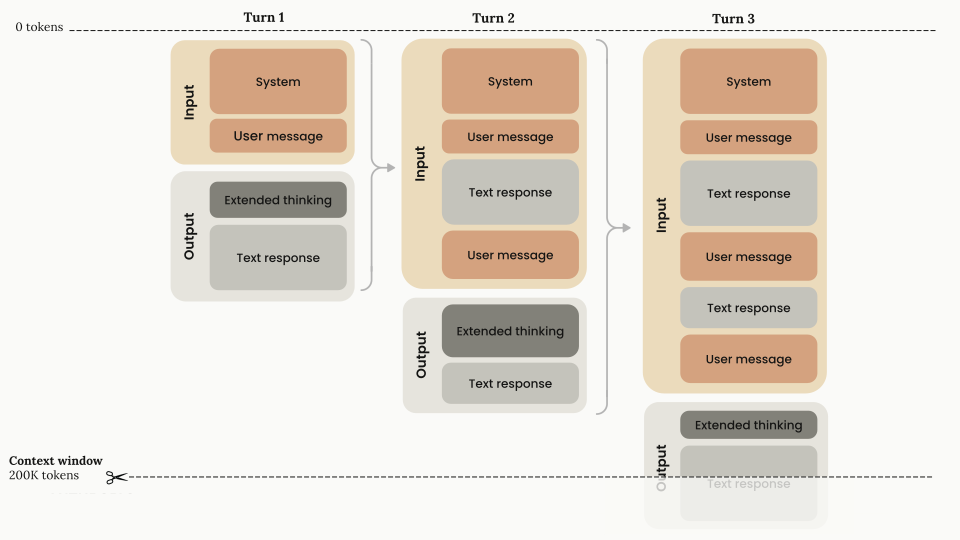
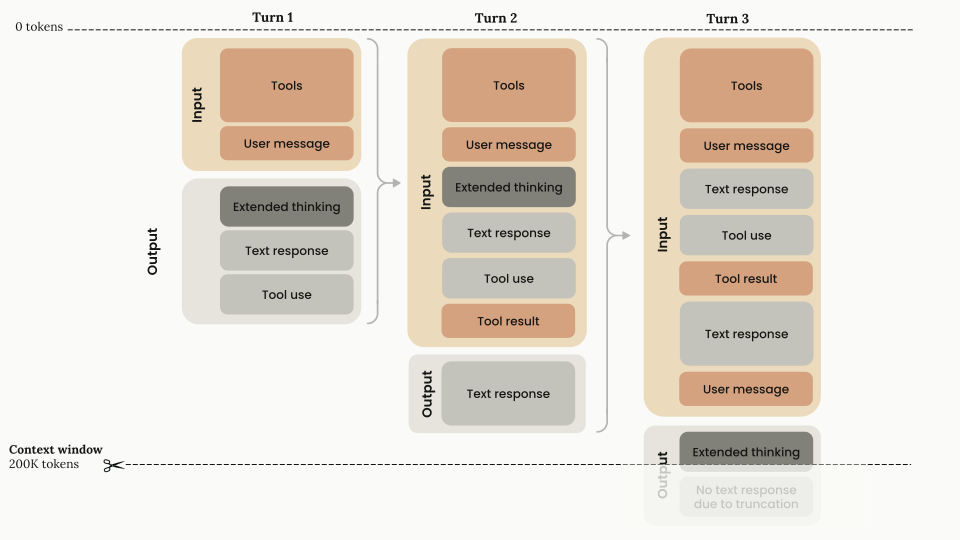
* **Prior-turn thinking** depends on the [preservation default](https://platform.claude.com/docs/en/build-with-claude/thinking#thinking-block-preservation-by-model). On [models that keep all prior turns](https://platform.claude.com/docs/en/build-with-claude/thinking#thinking-block-preservation-by-model), previous thinking blocks remain in context, count toward the window, and are billed as input tokens like the rest of the conversation history. On models that keep only the last turn, the API strips older thinking blocks automatically when you pass them back, so they don't consume window space or input tokens.
In practice:
* On keep-all models, budget your context window as if thinking were ordinary conversation history, because it is. Long agentic sessions accumulate thinking in context. Use [thinking block clearing](https://platform.claude.com/docs/en/build-with-claude/context-editing#thinking-block-clearing) if you need to reclaim space.
* On last-turn-only models, thinking is a per-turn cost only: each turn's thinking counts against that turn's `max_tokens` and then drops out of the window.
The following diagrams illustrate the last-turn-only (stripping) regime. The first shows a multi-turn conversation: each turn's thinking block is generated in the output but not carried into later turns' input.
The second shows the same regime with tool use: thinking stays in context alongside its tool result for the duration of the assistant turn, then drops out on the next user turn.
Use the [token counting API](https://platform.claude.com/docs/en/build-with-claude/token-counting) to get accurate counts for your specific use case, especially for multi-turn conversations that include thinking.
## Thinking encryption
Full thinking content is encrypted and returned in the `signature` field on each thinking block. The API uses the signature to verify that thinking blocks were generated by Claude when you pass them back.
Keep the following in mind when working with signatures:
* It is only strictly necessary to send back thinking blocks when [using tools with thinking](https://platform.claude.com/docs/en/build-with-claude/thinking#thinking-with-tool-use). Otherwise you can omit thinking blocks from previous turns. If you do pass them back, whether the API keeps or strips them depends on the model (see [Thinking block preservation by model](https://platform.claude.com/docs/en/build-with-claude/thinking#thinking-block-preservation-by-model)). Use [context editing](https://platform.claude.com/docs/en/build-with-claude/context-editing) to configure this.
* When sending back thinking blocks, pass everything back exactly as you received it, for consistency and to avoid potential issues.
* When [streaming responses](https://platform.claude.com/docs/en/build-with-claude/thinking#streaming-thinking), the signature arrives as a `signature_delta` inside a `content_block_delta` event just before the `content_block_stop` event.
* `signature` values are significantly longer in Claude 4 and later models than in previous models.
* The `signature` field is opaque: don't interpret or parse it.
* `signature` values are compatible across platforms (the Claude API, [Amazon Bedrock](https://platform.claude.com/docs/en/build-with-claude/claude-in-amazon-bedrock), and [Google Cloud](https://platform.claude.com/docs/en/build-with-claude/claude-on-vertex-ai)). Values generated on one platform work on another, except that thinking blocks from Claude Sonnet 5.5 and Claude Haiku 5.5 work only in the account that produced them or in an account linked to it. See [Thinking blocks stay with the account that produced them](https://platform.claude.com/docs/en/build-with-claude/preserved-thinking#account-bound-thinking).
## Redacted thinking blocks
In addition to regular `thinking` blocks, the API may return `redacted_thinking` blocks when portions of Claude's reasoning are safety-redacted. A `redacted_thinking` block contains encrypted thinking content in a `data` field, with no readable text:
```json
{
"type": "redacted_thinking",
"data": "..."
}
```
The `data` field is opaque and encrypted. Like the `signature` field on regular thinking blocks, pass `redacted_thinking` blocks back to the API unchanged when continuing a multi-turn conversation with [tools](https://platform.claude.com/docs/en/build-with-claude/thinking#thinking-with-tool-use).
If your code filters content blocks by type (for example, `block.type == "thinking"`) when round-tripping responses with tool use, also include `redacted_thinking` blocks. Filtering on `block.type == "thinking"` alone silently drops `redacted_thinking` blocks and breaks the multi-turn protocol described in [Preserving thinking blocks](https://platform.claude.com/docs/en/build-with-claude/thinking#preserving-thinking-blocks).
`redacted_thinking` blocks are a distinct content block type returned when thinking is safety-redacted. This is separate from the [`display: "omitted"`](https://platform.claude.com/docs/en/build-with-claude/thinking#controlling-thinking-display) option, which returns regular `thinking` blocks with an empty `thinking` field.
## Limits and feature compatibility
### Sampling parameters
On Claude Fable 5.1, Claude Mythos 5.1, Claude Fable 5, Claude Mythos 5, Claude Mythos Preview, Claude Opus 5.5, Claude Opus 5, Claude Opus 4.8, Claude Opus 4.7, Claude Sonnet 5.5, Claude Sonnet 5, and Claude Haiku 5.5, non-default `temperature`, `top_p`, or `top_k` values return a 400 error on every request, regardless of whether thinking is used. On these models, the `top_p` default is `0.99`, so a `top_p` of `1` returns a 400 error, and so does a request that includes both `temperature` and `top_p`, even at their defaults. See [Remove sampling parameters](https://platform.claude.com/docs/en/models/haiku-5-5/migration-guide#remove-sampling-parameters). On older models, the restriction applies only while thinking is on: `temperature` and `top_k` are incompatible with thinking, and `top_p` is allowed at values between 0.95 and 1.
### Response prefill and forced tool use
Claude 4.6 and later models and Claude Mythos Preview reject a prefilled final assistant turn with a 400 error, whether or not thinking is on (see [Prefill not supported](https://platform.claude.com/docs/en/api/errors#prefill-not-supported)). On earlier models, you can't prefill the assistant response while thinking is on. Forced tool use (`tool_choice: {"type": "any"}` or `{"type": "tool", ...}`) is incompatible with manual extended thinking but works with adaptive thinking. The exceptions are Claude Opus 5.5, Claude Sonnet 5.5, Claude Fable 5.1, and Claude Mythos 5.1, which reject forced tool use on every request with a 400 error. On those models, use `tool_choice: {"type": "auto"}` with [strict tool use](https://platform.claude.com/docs/en/agents-and-tools/tool-use/strict-tool-use) or [structured outputs](https://platform.claude.com/docs/en/build-with-claude/structured-outputs) instead. Where forced tool use is accepted, the response starts with the tool call and has no `thinking` block. To let the model think before it calls a tool, use `tool_choice: {"type": "auto"}` and say in the prompt when to use the tool. See [Thinking with tool use](https://platform.claude.com/docs/en/build-with-claude/thinking#thinking-with-tool-use).
### Output limits
Each model accepts `max_tokens` up to the ceiling listed here. On the [Message Batches API](https://platform.claude.com/docs/en/build-with-claude/batch-processing#extended-output-beta), the `output-300k-2026-03-24` [beta header](https://platform.claude.com/docs/en/api/beta-headers) raises that ceiling for the models with a batches ceiling listed.
| Model | Max output tokens | Batches beta ceiling |
| :-------------------- | :---------------- | :------------------- |
| Claude Fable 5.1 | 128K | — |
| Claude Mythos 5.1 | 128K | — |
| Claude Fable 5 | 128K | — |
| Claude Mythos 5 | 128K | — |
| Claude Mythos Preview | 128K | Not available |
| Claude Opus 5.5 | 128K | 300K |
| Claude Opus 5 | 128K | 300K |
| Claude Opus 4.8 | 128K | 300K |
| Claude Opus 4.7 | 128K | 300K |
| Claude Opus 4.6 | 128K | 300K |
| Claude Opus 4.5 | 64K | Not available |
| Claude Sonnet 5.5 | 128K | 300K |
| Claude Sonnet 5 | 128K | 300K |
| Claude Sonnet 4.6 | 128K | 300K |
| Claude Sonnet 4.5 | 64K | Not available |
| Claude Haiku 5.5 | 128K | 300K |
| Claude Haiku 4.5 | 64K | Not available |
See the [models overview](https://platform.claude.com/docs/en/models/overview) for limits on legacy models.
### Long requests
The SDK requires streaming when `max_tokens` is greater than 21,333, to avoid HTTP timeouts on long-running requests. This is a client-side validation, not an API restriction. If you don't need to process events incrementally, use `.stream()` (java: `.createStreaming()`; csharp: `.CreateStreaming()`; go: `.NewStreaming()`; php: `->createStream()`) with `.get_final_message()` (typescript: `.finalMessage()`; ruby: `.accumulated_message`; csharp: `.Aggregate()`; go: `message.Accumulate(event)`; java, php: `MessageAccumulator`) to get the complete `Message` object without assembling it from individual events yourself. See [Streaming Messages](https://platform.claude.com/docs/en/build-with-claude/streaming#get-the-final-message-without-handling-events). Expect longer response times when thinking is active, because generating thinking blocks adds processing time. For workloads that push thinking above roughly 32k tokens per request, use [batch processing](https://platform.claude.com/docs/en/build-with-claude/batch-processing) to avoid networking issues: such requests can run long enough to hit system timeouts and open connection limits.
## Next steps
Steer how often and how deeply Claude thinks with effort levels, system prompt guidance, and per-message steering, and understand thinking's cost and pricing.
Walk through a complete two-turn tool-use round trip that preserves thinking blocks correctly, and see how interleaved thinking changes the flow.
Find out whether your Messages API integration edits conversation history, and replace each edit with the API feature that keeps earlier thinking blocks valid.
Diagnose and fix the most common thinking failures: configuration 400 errors, empty or missing thinking blocks, max\_tokens stops, and cache misses.
Control how many tokens Claude uses when responding with the effort parameter, trading off between response thoroughness and token efficiency.